
What Is the Frost Line?
The frost line has two meanings. In a building code it is the minimum depth a footing must reach, set by the local jurisdiction. In nature it is how deep the ground actually freezes in a given winter. This page separates the two, explains what makes frost go deeper, and shows how to find the number that applies to your site.
- Checked October 2026
- 4 sources
- How we verify
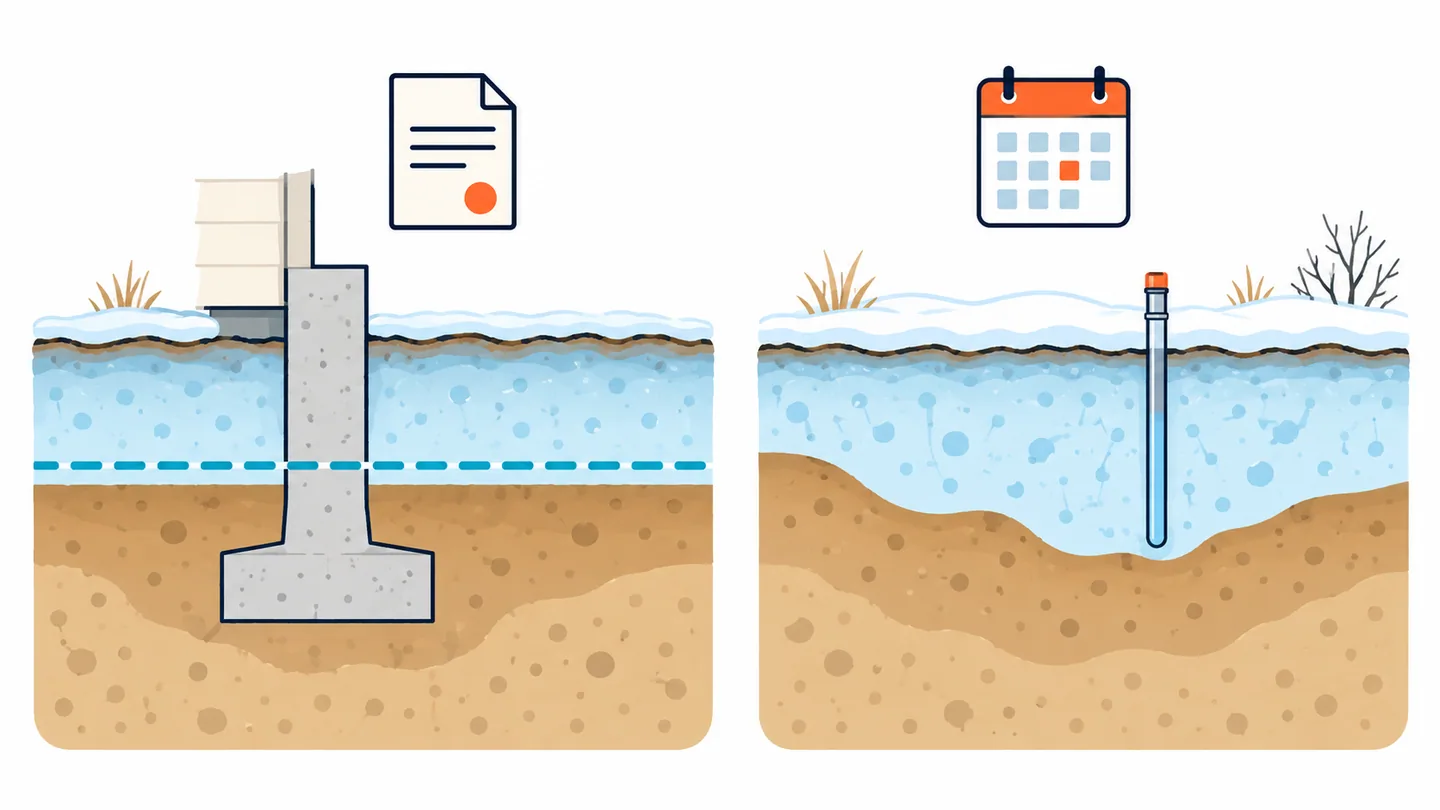
- Code frost lineA legal minimumFooting depth below finish grade, filled in by the jurisdiction. IRC Table R301.2, footnote b.
- Physical frost depthChanges every winterHow deep soil water actually freezes. Measured, not set.
- Minimum footing depth anywhere12 inBelow undisturbed ground, even where frost never reaches it. IRC R403.1.4.
What Does Frost Line Mean in a Building Code?
The frost line is the depth below the surface that frost is expected to reach. In a building code it is a minimum footing depth set by your local jurisdiction, not a measurement. The International Residential Code tells each jurisdiction to fill in the frost line depth column with the minimum depth of footing below finish grade (Table R301.2, footnote b).
The same words also describe nature. The physical frost depth is how far the soil water in the ground actually froze in a given winter. Codes use the first meaning. Weather stations report the second.
Is the Code Frost Line the Same as How Deep the Ground Freezes?
No. The code frost line is a fixed legal minimum, while the physical frost depth is a measurement that changes every winter. A code value is chosen to be safe in a hard winter, so it is usually deeper than what a typical winter produces.
| Code frost line | Physical frost depth | |
|---|---|---|
| Who sets it | Your jurisdiction | Weather, snow and soil |
| How often it changes | When the code is amended | Every winter |
| How it is found | Look up your local code | Frost tube or soil sensors |
| What it is used for | Footing and pipe depth | Research, road load limits |
Minnesota shows the gap. The state code sets 42 or 60 inches depending on the zone, while the Minnesota DNR State Climatology Office reported frost near 25 inches under sod in winter 2025. The code protects against the worst winter, not the average one.
How Deep Is the Frost Line in the United States?
Code frost line depths run from the 12 inch minimum footing depth in warm areas up to 60 inches in northern Minnesota. Massachusetts uses 48 inches and Rhode Island 40 inches. Your own number depends on your local code, so look up your ZIP code or open the state list.
What Makes the Frost Line Deeper in Some Places?
Frost goes deeper where winters are colder and longer, where the ground is bare, and where the soil holds water. Four things matter most:
- Air temperature over the winter. The code measures this as the air freezing index, a 100-year value in degree-days (see frost penetration depth).
- Snow cover. Snow insulates the ground, so frost reaches less deep under a thick snowpack than on plowed pavement.
- Soil type and moisture. Wet, fine soils such as clay hold water that freezes and heaves. Free-draining gravel has less water to freeze.
- The surface. Cleared pavement, bare soil and sod freeze to different depths.
Why Do Builders Dig Below the Frost Line?
Builders go below the frost line so footings and pipes sit in soil that will not freeze and lift. Frozen soil with water in it expands, which pushes up whatever sits in it. The IRC protects footings from frost by extending below the frost line, by using a frost-protected shallow foundation, by following ASCE 32, or by building on solid rock (R403.1.4.1). Water service pipe goes at least 12 inches deep and 6 inches below the frost line (P2603.5).
How Deep Do You Need to Dig to Get Below the Frost Line?
Dig to the frost line depth your local code sets, measured to the bottom of the footing. Never less than 12 inches below undisturbed ground. See footing depth for structures and water line depth for pipes.
What Happens If You Build Above the Frost Line?
A footing above the frost line sits in soil that can freeze, and frozen soil can lift it. Posts, piers and slabs can rise unevenly in winter and settle back in spring, which cracks slabs and racks doors. The IRC also says footings shall not bear on frozen soil unless the frozen condition is permanent. Read frost heave for how it happens.
How Do You Find the Frost Line Where You Live?
Use your ZIP code, then confirm with your building department.
- Enter your ZIP code in the box on this page or on the home page.
- Check your state page if your place is not listed.
- Ask the local building department for the number it enforces, since local amendments override the model code.
Where Can You Learn More About Frost and the Code?
These guides go deeper into each part of this page, from how frost behaves in soil to the code sections that set the rules.
| Topic | What the guide covers |
|---|---|
| Frost penetration depth | How deep the ground actually freezes, and why |
| Current frost depth | Where official live frozen-ground readings are published |
| How to measure frost depth | Frost tubes, soil sensors and what they show |
| Ground temperature below the frost line | How soil temperature changes with depth |
| Frost heave | Why frozen soil lifts footings and posts |
| Clay soil and frost | How clay behaves in freezing weather |
| Gravel and frost | Why gravel drains but does not stop frost |
| IRC frost depth rules | The residential code sections, edition by edition |
| IBC frost depth rules | The commercial code rule and its exemption |
| Ground snow load | The other value in your local design table |
Questions People Ask
What does below the frost line mean?
It means the bottom of the footing, post or pipe sits deeper than the depth your local code sets for frost. The depth is measured from finish grade to the bottom of the footing.
Is frost depth the same as the frost line?
People use the words interchangeably. Strictly, frost depth is a measurement of frozen ground in one winter, and the frost line in a building code is the fixed minimum depth the jurisdiction requires.
Can the frost line change?
The code frost line changes only when your jurisdiction amends its code or adopts a new edition. The physical frost depth changes every winter with temperature, snow cover and soil moisture.
What Is Your Frost Line Depth?
Enter a ZIP code or city to see the depth your own building code sets.