
What Is a Frost-Protected Shallow Foundation?
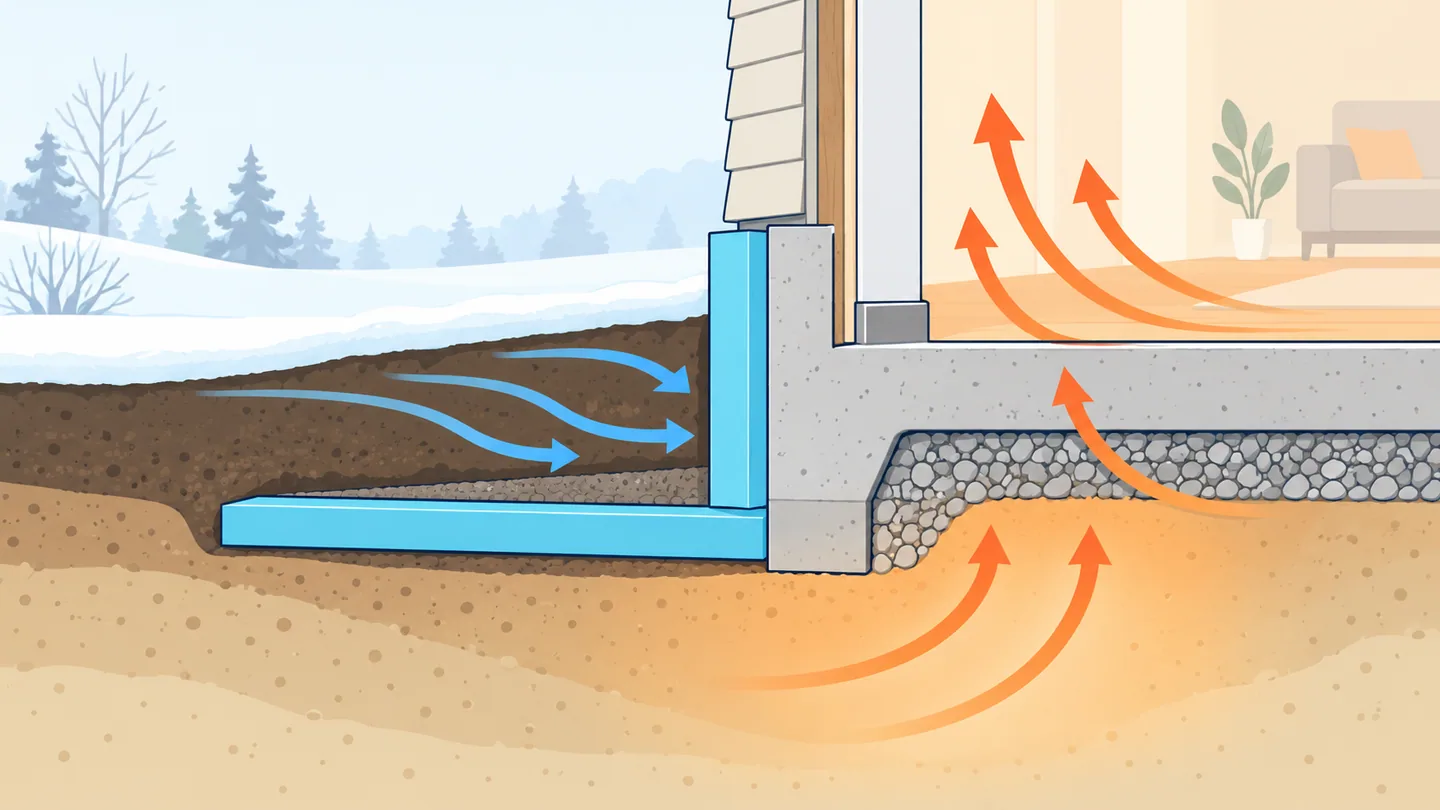
A frost-protected shallow foundation keeps the ground under a building from freezing by wrapping a shallow footing with rigid insulation, so the footing does not have to reach the frost line. The IRC allows it for heated buildings, sized by the air freezing index of your area. This page explains how it works, the main rules, where it is not allowed and the common problems.
- Checked October 2026
- 3 sources
- How we verify
- Heated building rule64 °F monthly meanMinimum for the IRC R403.3 method.
- Insulation standardASTM C578For below-grade rigid insulation. IRC R403.3.
- Unheated buildingsNeed ASCE 32Not covered by the IRC prescriptive method.
What Does a Frost-Protected Shallow Foundation Do?
A frost-protected shallow foundation (FPSF) is a footing placed near the surface and wrapped in rigid insulation so the soil under it does not freeze. It is one of four ways the IRC allows you to meet the frost rule, along with digging below the frost line, following ASCE 32, or building on solid rock (R403.1.4.1). The footing still sits at least 12 inches below undisturbed ground.
How Does an FPSF Stop Frost Heave?
It keeps the ground warm, so there is no ice to heave. Heat leaking from the heated building warms the soil around the footing. Insulation on the outside of the foundation, and sometimes a flat “wing” of insulation extending outward, holds that heat in and keeps cold from reaching the footing. No freezing means no ice lenses; see frost heave.
What Are the IRC Requirements for FPSF?
The prescriptive method in R403.3 applies only to heated buildings kept at a monthly mean temperature of at least 64 °F (18 °C). The main rules:
| Item | IRC R403.3 rule |
|---|---|
| Building | Heated, monthly mean at least 64 °F |
| Insulation | R-values and layout from Table and Figure R403.3(1), by air freezing index |
| Material | Below-grade insulation to ASTM C578 |
| Not allowed for | Unheated porches, utility rooms, garages, carports; attachments to spaces kept below 64 °F |
| Unheated buildings | Design to ASCE 32 instead |
How Much Insulation Does an FPSF Need?
It depends on the air freezing index, and on the footing depth you choose. The IRC gives the required R-values and horizontal insulation distances in Table R403.3(1). We do not reproduce the table here; use the printed code and your jurisdiction’s amendments.
What Is Your Air Freezing Index?
The air freezing index is a 100-year return period value listed in your jurisdiction’s design table (Table R301.2, footnote i). The IRC also gives a map in Figure R403.3(2). Ask your building department for the number it uses.
Can Unheated Buildings Use FPSF?
Yes, but only by design under ASCE 32, not by the IRC prescriptive method. ASCE/SEI 32-01 covers both heated and unheated buildings. Practitioners report that unheated designs normally need a licensed engineer’s approval. If you want a detached garage or shed on insulated slab, ask the building department what it will accept.
What Are Common Problems With Shallow Foundations?
Most come from losing the protection that keeps the ground from freezing:
- Insulation that is damaged, wet or left exposed above grade.
- A building that is not kept warm in winter, so the heat source disappears.
- Poor drainage around the footing.
- Using the wrong air freezing index or an old table.
- Using it for an unheated space such as a porch or garage without an engineered design.
FPSF vs Digging Below the Frost Line: Which Costs Less?
It varies. FPSF means a shallower hole but adds insulation and fill, and practitioners report the extra cost can offset the savings, especially in unheated or lightly heated buildings. Compare your own quotes. For depths where you can dig, see footing depth.
Questions People Ask
How can I protect my footings from frost?
Extend them below the frost line, use a frost-protected shallow foundation, follow ASCE 32, or build on solid rock. These are the four methods listed in IRC R403.1.4.1.
What are common problems with shallow foundations?
Missing or damaged insulation, loss of heat in the building, wet or poorly drained soil, and designing for the wrong air freezing index. Each can let the ground freeze under the footing.
Is a frost-protected shallow foundation cheaper?
Sometimes, because the footing is shallower. Insulation and extra fill add cost, and practitioners report that the savings can shrink or disappear. Compare quotes for your site.
What Is Your Frost Line Depth?
Enter a ZIP code or city to see the depth your own building code sets.