
How Deep Should Fence Posts Be?
Fence post depth is set by two limits, and the deeper one wins. One is leverage: bury about half of the post's above-ground height, on a gravel base. The other is location: your frost line or a local fence rule. This page gives hole depth, width and post length for 3 to 8 ft fences, then covers 2-foot holes, the frost line, materials, gate posts, setting a post so it won't heave, soil, and common mistakes.
- Checked October 2026
- 7 sources
- How we verify
- Rule of thumb, wood fence½ of above-ground heightEquals one-third of the post's total length. Minimum 24 in. Common practice, not code.
- 6 ft privacy fence36 in deep, 9 ft postPlus 6 in of gravel. Deeper if your frost line is deeper.
- National code for fence post depthNoneIRC R105.2 only exempts fences up to 7 ft from a permit.
How Deep Should a Fence Post Be?
A fence post should be buried about half as deep as it stands above ground, with at least 24 inches (61 cm) in the ground and 6 inches of gravel under it. For a 6 ft fence that means a 9 ft post with 36 inches (91 cm) buried. Go deeper if your frost line or local code requires it.
No national code sets the number. The rule comes from builders’ practice, and the deeper of two limits wins: the leverage limit from the fence height, and the location limit from your frost line or local fence rule. Look up your frost line depth to see the second one.
Is “one-third of the post” the same as “half the height”?
Yes. Burying one-third of a post’s total length is the same rule as burying half of its above-ground height. If the post is L long and one-third is buried, two-thirds stand above ground, so the buried part is half of that. A 9 ft post buried 3 ft leaves 6 ft above ground: 3 ft is half of 6 ft.
A lighter rule exists too, one-third of the above-ground height, which gives 24 inches for a 6 ft fence. It suits low fences in firm soil. A 6 ft privacy fence acts as a sail in wind, so the half-height rule is the safer reading.
How Deep Should Fence Posts Be for Each Fence Height?
The chart below applies the half-height rule with a 24 inch minimum, on top of a 6 inch gravel base. Add the gravel to the burial depth to get the hole depth, and add burial depth to fence height to get the post length. Deeper still where your frost line or code asks.
| Fence height | Half-height rule | One-third rule | Hole depth, with gravel | Post length |
|---|---|---|---|---|
| 3 ft | 24 in (minimum) | 24 in (minimum) | 30 in | 5 ft, buy 6 ft |
| 4 ft | 24 in | 24 in (minimum) | 30 in | 6 ft |
| 5 ft | 30 in | 24 in (minimum) | 36 in | 7.5 ft, buy 8 ft |
| 6 ft | 36 in | 24 in | 42 in | 9 ft, buy 10 ft |
| 7 ft | 42 in | 28 in | 48 in | 10.5 ft, buy 12 ft |
| 8 ft | 48 in | 32 in | 54 in | 12 ft |
Hole width is commonly 3 to 4 times the post width: 10 to 14 inches for a 4x4 (3.5 in actual) and 16 to 22 inches for a 6x6 (5.5 in actual). The fence post depth calculator fills in the row for your height and your frost line.
Do you use 8 or 10 ft posts for a 6 ft fence?
Use a 10 ft post for a 6 ft fence. The fence needs 36 inches buried and 6 ft above ground, so the post must be at least 9 ft long, and 10 ft is the next stock length. An 8 ft post would leave only 24 inches in the ground, which is the one-third rule for a 6 ft fence and shallow for a privacy fence.
Is 2 Feet Deep Enough for a Fence Post?
Two feet (24 inches) is enough for a fence up to about 4 ft tall, set in firm soil away from deep frost. It is not enough for a 6 ft privacy fence, which needs about 36 inches, or for any fence where your frost line is deeper than 24 inches and the post is set in concrete.
Four conditions push the answer past 24 inches:
- Fence height above 4 ft, because wind load grows with the fence’s area.
- A frost line deeper than 24 in, where concrete-set posts can heave.
- Loose or sandy soil, which gives less grip.
- A gate, corner or end post, which carries extra load.
Do Fence Posts Need to Go Below the Frost Line?
No national building code requires fence posts to go below the frost line, but some local codes do. The International Residential Code frost rule covers building footings, and its section R105.2 only exempts fences up to 7 ft from a building permit. It sets no post depth. Cook County, Illinois, is one local example.
The Cook County Department of Building and Zoning states that fence post holes must be dug 42 inches deep. Zoning rules and homeowners’ association rules can add their own limits, so ask your building department and your association before you dig.
Even where no rule applies, frost can lift a post set in concrete. Posts set in gravel in free-draining soil are far less likely to heave. For your own number, look up your frost line depth by ZIP code.
Frost line depths vary a lot by state. A few we have verified in official codes: Rhode Island 40 in, Massachusetts 48 in, and Minnesota 42 in or 60 in by county zone. See the frost line map for every state, or the Minnesota page for a state with two zones.
How Deep Should Wood, Vinyl, Metal and Split-Rail Fence Posts Be?
Post material changes the hole size more than the depth. Wood posts follow the half-height rule. Vinyl manufacturers we reviewed ask for about 30 to 36 inches depth, a hole 12 inches wide, and 40 inches for an 8 ft fence. Metal and split-rail posts follow their maker’s sheet.
| Material | Typical post | Typical burial | Setting | Source |
|---|---|---|---|---|
| Wood (4x4, 6x6) | 4x4 to 6x6 | Half of above-ground height, 24 in minimum | Concrete or compacted gravel | Common practice |
| Vinyl | 4 in or 5 in sleeve | 30 to 36 in; 40 in for 8 ft fences | Concrete, hole 10 to 12 in wide | Manufacturer instruction sheets |
| Aluminum, steel | Per product | Per the maker’s sheet | Usually concrete | Check the sheet that ships with it |
| Split-rail | Round or 4x6 | Start from the half-height rule | Gravel or concrete | Check the rail maker |
Some vinyl instruction sheets set the hole depth at your frost depth plus 6 inches of gravel, so a deep frost line can override the 30 to 36 inch figure. For chain link, which has its own post types, see chain link fence post depth.
How Deep Should Gate, Corner and End Posts Be?
Gate, corner and end posts carry more load than line posts, so set them deeper and use a larger post. A common rule is about 6 inches deeper than the line posts, with a 6x6 for a wood gate. That puts a post for a 6 ft gate at about 42 inches, and builders often go deeper on heavy gates.
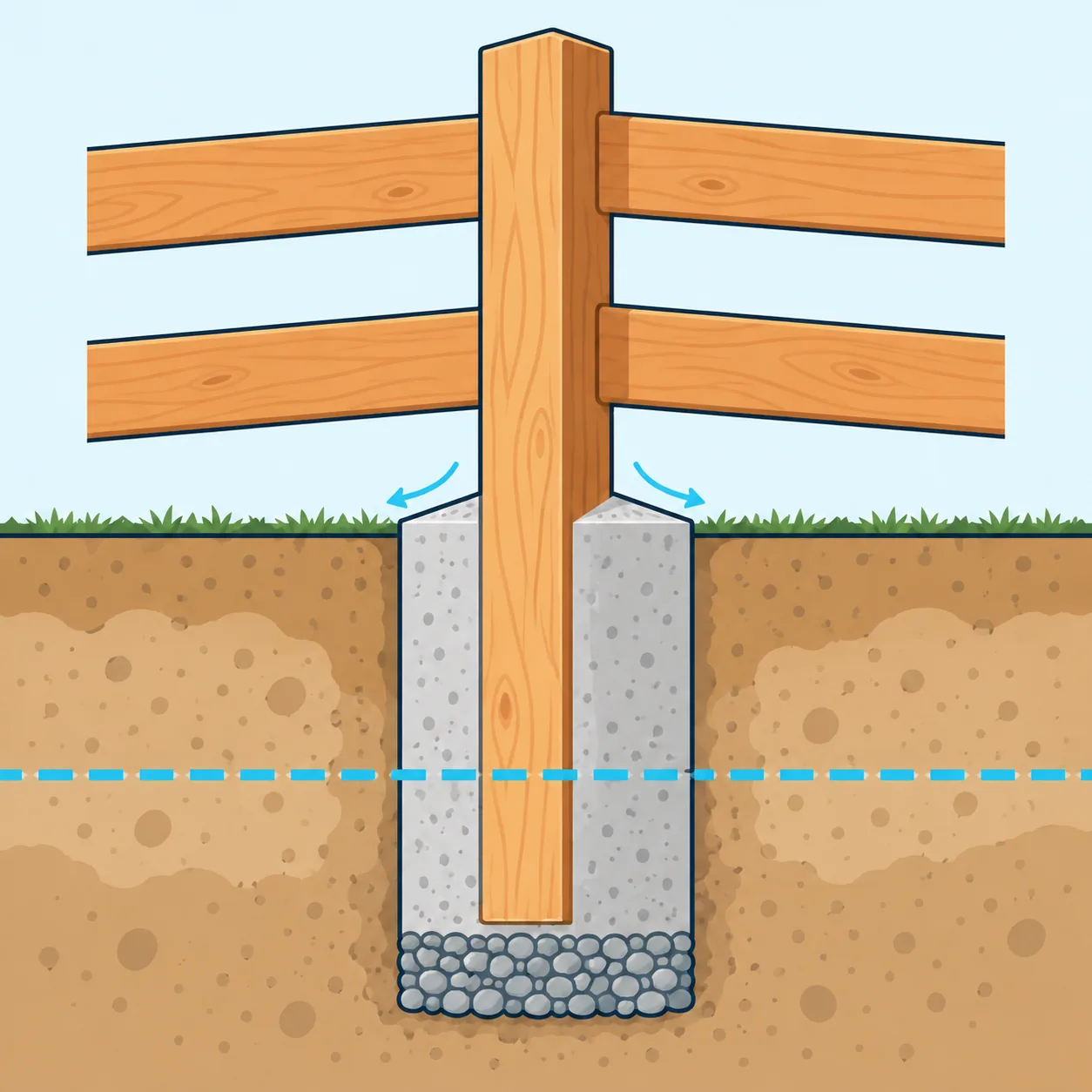
The swing of a gate pulls the post sideways every time it opens. A post that is too shallow leans first at the gate, and the gate then drags. Concrete around a gate post helps, and its collar should slope away from the post so water runs off.
How Do You Set a Fence Post So It Doesn’t Heave?
Call 811 first, then dig below your required depth, add gravel, set the post plumb, and slope the surface away from it.
- Call 811 a few working days before you dig, so buried lines are marked.
- Mark and dig each hole to the hole depth in the chart, wider at the top only if the soil is loose.
- Add 6 inches of gravel and compact it. It drains water away from the post bottom.
- Set the post on the gravel, plumb in both directions, and brace it.
- Fill with concrete or compacted gravel and soil, in layers if you tamp.
- Slope the top of the concrete away from the post so water sheds.
- Wait for the concrete to cure before you hang the fence.
Concrete in a heave-prone soil can be gripped by frozen ground along its sides, which is why the frost line matters for concrete-set posts. One chain-link manufacturer’s guide asks for holes with sloping sides, a single continuous pour, and a troweled top sloped to shed water. The calculator shows how many bags each hole takes.
How Does Soil Change Fence Post Depth?
Loose sand needs a deeper, wider hole, and clay needs good drainage, because soil decides how well a post stays put. Rocky ground may force a shallower hole set with a bracket. These are practices, not code figures, so treat them as a starting point.
| Soil | Effect on the post | What builders do |
|---|---|---|
| Sand | Less grip, drains fast | Go deeper and wider, tamp well |
| Loam | Firm, moderate drainage | Follow the chart |
| Clay | Holds water, heaves with frost | Add gravel base, slope the surface; see clay soil and frost depth |
| Rocky | Hard to dig | Hand-dig to rock or use a bracket |
Why Do Fence Posts Heave Out of the Ground in Winter?
Fence posts heave when water in the soil freezes into ice lenses and lifts whatever is sitting in the frozen layer. A post set in concrete can be gripped along its sides by frozen soil and pulled up a little each winter. Thaw lets the soil settle around the gap, so the post does not come back down.
Frost heave explains the three conditions that cause it. Removing any one of them stops it.
What Are the Most Common Fence Post Depth Mistakes?
The most common mistakes come from using one rule without checking the other.
- Using a flat 24 inches for every height.
- Ignoring the frost line when posts go into concrete.
- Skipping the gravel base, so water sits at the post bottom.
- Setting gate and corner posts as shallow as line posts.
- Digging before you call 811.
- Skipping the post-length math, then finding the post too short to bury properly.
Which Fence or Post Guide Do You Need?
Fence type changes the hole size, the setting material and which posts take the most load. These guides cover the common cases.
| Post | What the guide covers |
|---|---|
| Fence post depth calculator | Hole depth, post length and concrete for your fence |
| Chain link fence posts | Terminal and line post holes, from the manufacturer’s guide |
| Farm fence posts | Corner, brace and line posts for field fencing |
| Mailbox posts | Height, setback and breakaway posts |
| Basketball hoop posts | In-ground hoop footings from maker instructions |
Questions People Ask
How deep should an 8 ft fence post be buried?
About 4 ft (48 in) for an 8-ft fence, which makes the post 12 ft long, plus 6 inches of gravel under it. Taller fences catch more wind, so they get the full half-height rule, and a deeper frost line raises it further.
Is 24 inches deep enough for a fence post?
Yes for a fence up to about 4 ft tall in firm soil outside a frost-heave problem. No for a 6 ft privacy fence, which wants about 36 inches. Check your frost line and any local fence rule before you settle on 24.
Is 2 feet deep enough for a 10-foot post?
A 10-ft post set 2 ft deep leaves 8 ft above ground, and the half-height rule asks for 4 ft of burial. It is shallow for that height, so expect leaning in wind or soft soil. Set it deeper or brace it.
Do you use 8 or 10 ft posts for a 6 ft fence?
Use a 10 ft post for a 6 ft fence. A 6 ft fence needs 36 inches buried, so the post must be 9 ft long at least, and 10 ft is the next stock length. An 8 ft post would leave only 24 inches in the ground.
How deep should a 6x6 gate post be?
Set a gate post deeper than the line posts, commonly about 6 inches more, and use a larger post, often a 6x6, because the gate swings load onto it. For a 6 ft gate that puts the post at about 42 inches deep.
How deep should a vinyl fence post be?
Vinyl fence manufacturers we reviewed ask for about 30 to 36 inches, 12 inches wide, with 40 inches for an 8 ft fence. Follow the sheet that comes with your product, since depth varies by maker.
What Is Your Frost Line Depth?
Enter a ZIP code or city to see the depth your own building code sets.