
What Is Frost Penetration Depth?
Frost penetration depth is how far the ground actually freezes in a given winter. It depends on how cold the winter is, how much snow covers the ground, and what the soil is like. This page explains how it is measured and estimated, how it differs from the code frost line your building department sets, and why footings go deeper than a typical winter's frost.
- Checked October 2026
- 4 sources
- How we verify
- Measured withFrost tubes, soil sensorsSee how to measure frost depth.
- Code frost lineSet by your jurisdictionFixed minimum, not this winter's reading.
- Air freezing index100-year valueIRC Table R301.2, footnote i.
What Does Frost Penetration Depth Mean?
Frost penetration depth is the depth to which the ground freezes in a given winter. It is an observation, so it is different every year. It is not the same as the frost line in a building code, which is a fixed minimum footing depth chosen by the jurisdiction.
Is Frost Penetration Depth the Same as the Frost Line?
Not quite. The frost line in a code is a design minimum, while frost penetration is what winter actually did.
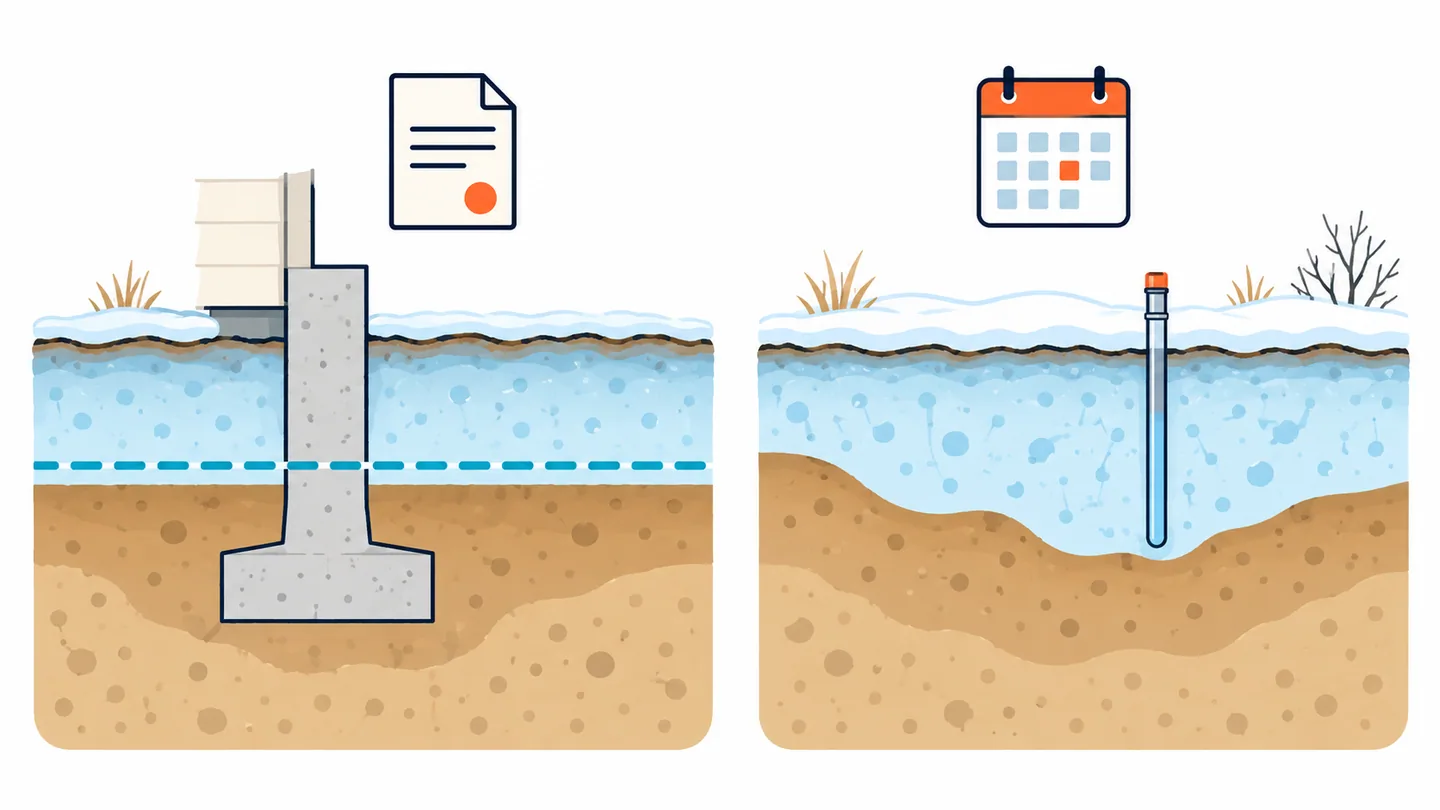
| Frost penetration depth | Code frost line | |
|---|---|---|
| What it is | Measured depth of frozen ground | Minimum footing depth |
| Changes yearly | Yes | Only when the code changes |
| Source | Frost tubes, sensors | Local building code |
What Controls How Deep Frost Goes?
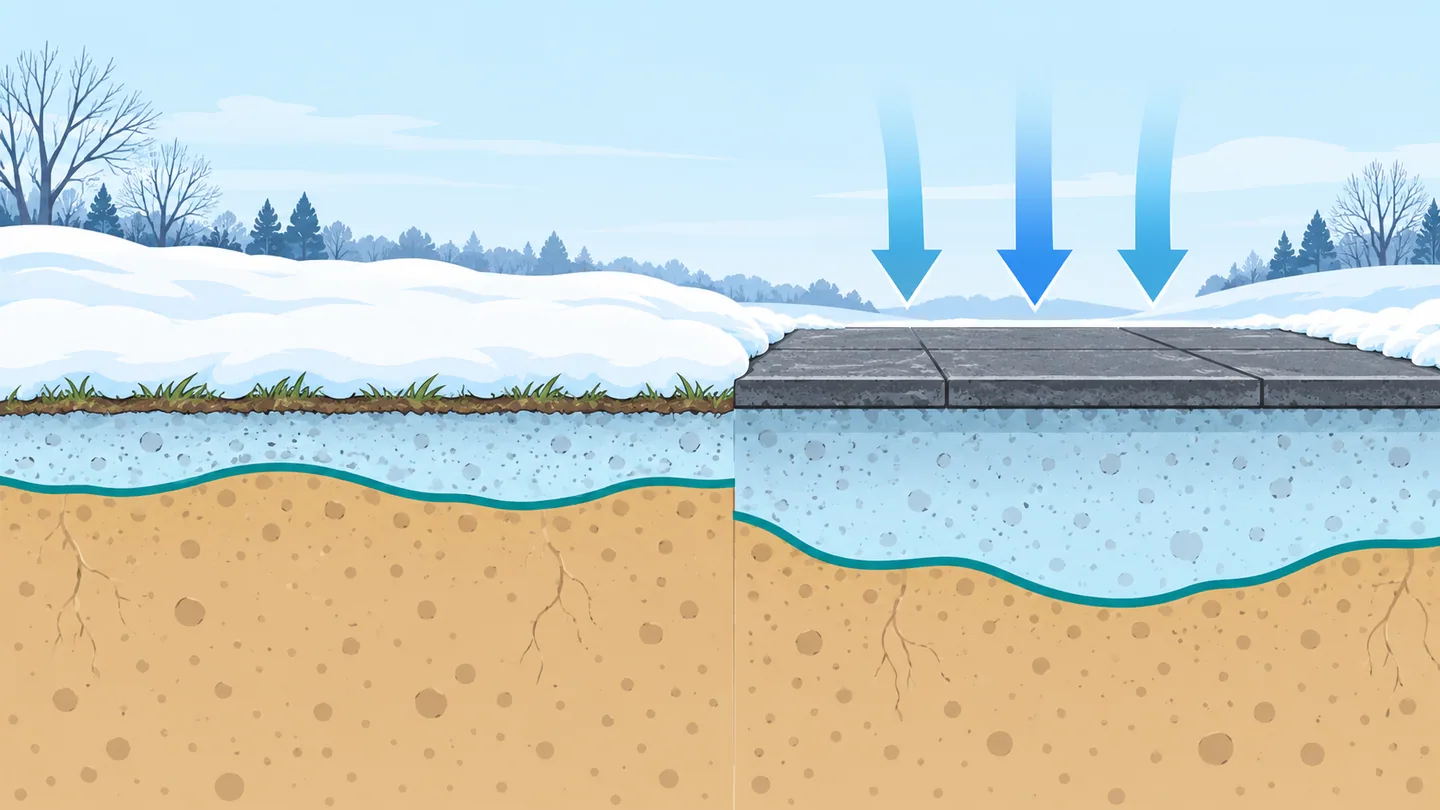
Four things decide it: how cold and long the winter is, the snow cover, the soil, and the surface. Colder, longer winters push frost deeper. Snow on the ground slows it. Wet fine soils hold more water to freeze, and bare or plowed surfaces lose heat fastest. The Minnesota DNR State Climatology Office notes that snow cover insulates the ground in its winter 2025 frost summary.
What Is the Air Freezing Index?
The air freezing index is a measure of how cold a winter is, counted in degree-days below 32 °F. The IRC asks jurisdictions to list it as a 100-year return period value (Table R301.2, footnote i), and uses it to size insulation for frost-protected shallow foundations. Look up your local value in your state or county design table.
Does a Colder Winter Mean a Deeper Code Frost Line?
Usually, but not by formula. Many local design tables list the air freezing index right next to the frost line depth, so we can compare the two from the same official document. Colder places generally set deeper frost lines, yet jurisdictions with similar winters still choose different numbers.
| Jurisdiction | Air freezing index (°F-days) | Frost line depth |
|---|---|---|
| Jefferson Parish, LA | 40 | 12 in |
| Dallas, TX | 150 | 6 in |
| Seattle, WA | 250 | 12 in |
| Nashville, TN | 366 | 12 in |
| Smithtown, NY | 452 | 36 in |
| Philadelphia, PA | 500 | 30 in |
| Denver, CO | 712 | 36 in |
| Kansas City, MO | 1,000 | 36 in |
| Omaha, NE | 1,680 | 42 in |
| Missoula County, MT | 2,000 | 36 in |
| Juneau, AK | 2,500 | 32 in |
| Butte-Silver Bow, MT | 2,500 | 42 in |
| Sioux Falls, SD | 3,000 | 42 in |
Juneau and Butte list the same freezing index but frost depths 10 inches apart, and Smithtown sets three times Nashville’s depth with a similar index. The code number reflects local experience, soils and history as well as cold, which is why you need your own jurisdiction’s figure. Values are from each jurisdiction’s adopted Table R301.2, read in October 2026; see the sources page.
How Do You Determine Frost Depth at a Site?
For design, start with the code. For curiosity or research, use measured data.
- Look up the code frost line for your ZIP code, then confirm it with your building department.
- Check current readings from official networks near you.
- To measure it yourself, read how to measure frost depth.
- For unusual soils or large structures, ask a geotechnical engineer.
How Deep Does Frost Penetrate in a Typical Winter?
It changes a lot from one winter to the next, even at one spot. NDSU’s soil sensors at Carrington, North Dakota recorded the deepest frost each winter from 2015 to 2024:
| Winter | Deepest frost | First reached | Last day of soil frost |
|---|---|---|---|
| 2015 | 39 in | Feb 25 | Apr 22 |
| 2016 | 31 in | Feb 20 | Mar 24 |
| 2017 | 24 in | Jan 11 | Apr 12 |
| 2018 | 49 in | Mar 8 | May 9 |
| 2019 | 69 in or more | Mar 22 | May 12 |
| 2020 | 31 in | Feb 24 | Apr 30 |
| 2021 | 31 in | Feb 14 | Apr 1 |
| 2022 | 31 in | Feb 24 | Apr 21 |
| 2023 | 20 in | Feb 27 | Apr 24 |
| 2024 | 24 in | Jan 23 | — |
The median was 31 inches, but the deepest winter went past the sensors at 69 inches, and NDSU notes a water main about 8 feet down froze that year. The shallowest was 20 inches. A footing has to survive the 2019 winter, not the median one, which is why the code depth sits well below a typical year’s frost.
Why Is the Code Frost Line Deeper Than Measured Frost?
A code has to cover a hard winter with bare ground, not an average one. Measured frost in a normal winter with snow cover is usually shallower. Minnesota is one example: frost near 25 inches under sod in 2025 against a 42 or 60 inch code depth. Footings also carry a building for decades, so a single mild winter is no guide.
How Do Soils Change Frost Penetration?
Fine soils such as silt and clay hold water and are the most frost-susceptible. Coarse, well-drained soil such as gravel holds little water to freeze. The soil also affects how fast cold moves downward. The code frost line does not change with soil, but a soils report may let an engineer design differently.
How Do Builders Deal With Frost Penetration?
They keep footings out of freezing ground. The IRC lists four ways (R403.1.4.1):
- Extend the footing below the frost line.
- Use a frost-protected shallow foundation.
- Build to ASCE 32.
- Build on solid rock.
Questions People Ask
How deep does frost penetrate the ground?
It depends on the place and the winter. In mild climates frost may reach only a few inches or not at all, while in the northern states it can reach several feet. Your local code frost depth is the safe design figure.
Does snow stop frost from going deeper?
Snow insulates the ground, so a deep early snowpack usually keeps frost shallower than bare ground in the same cold. That is why measured frost can be much less than the code depth.
Should I use measured frost depth to size a footing?
No. Use the code frost line, since inspectors enforce it. Measured frost depth describes one winter and can be exceeded in a harder one.
What Is Your Frost Line Depth?
Enter a ZIP code or city to see the depth your own building code sets.