
How Deep Are Water Lines Buried?
A water service line must be buried at least 12 inches deep and at least 6 inches below the frost line under the International Residential Code. States that use the Uniform Plumbing Code or their own rules set it against the local frost depth too, sometimes deeper. This page shows how to work out your depth, answers whether 18 inches is enough, and covers pipe materials, driveways, trench bedding, and what to do when you can't dig that deep.
- Checked October 2026
- 10 sources
- How we verify
- IRC water service pipe12 in deep and 6 in below frostBoth conditions apply. IRC P2603.5, 2018 and 2021.
- Minnesota12 in below maximum frostBuilding supply and yard piping, Minnesota Rules 4714.0609.
- Hawaii (UPC-based)12 in below average frostAnd 12 in of cover. Hawaii Plumbing Code 2021, section 609.1.
What Is the Burial Depth for a Water Line?
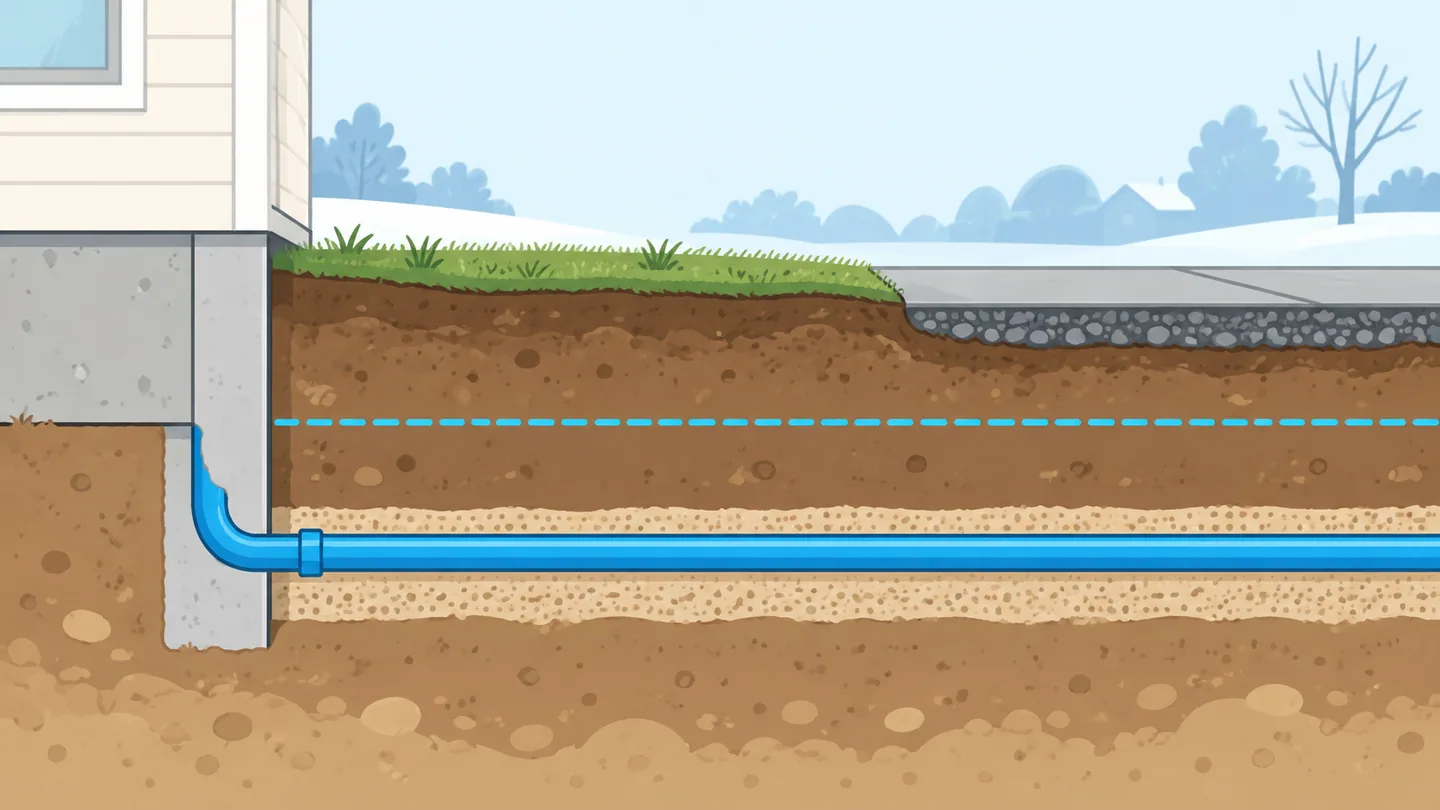
A water service line must be buried at least 12 inches (30 cm) deep and at least 6 inches (15 cm) below the frost line under the International Residential Code. Section P2603.5 sets both conditions, and both must be met, so the deeper one governs. Some states require more.
The 2018 and 2021 editions of the code read the same here. The rule covers the pipe from the meter or well to the house, not the city’s main in the street. The frost line is the number your own jurisdiction lists, so the burial depth is a local figure. Look up your frost line depth and add 6 inches.
How Deep Do You Bury a Water Line Where You Live?
Add 6 inches to your local frost line depth, and never go shallower than 12 inches. That is the IRC rule. A frost line of 42 inches gives a burial depth of 48 inches, a frost line of 60 inches gives 66, and a frost line of 12 inches or less gives 18 inches or the 12 inch minimum, whichever is greater.
| Local frost line | Burial depth under the IRC |
|---|---|
| None, or less than 6 in | 12 in |
| 12 in | 18 in |
| 30 in | 36 in |
| 42 in | 48 in |
| 60 in | 66 in |
Frost line depths we have verified in official codes include 40 inches in Rhode Island, 48 inches in Massachusetts and 42 or 60 inches in Minnesota depending on county. Many warm-climate codes list little or none. See the frost line map or look up your address.
Is 18 Inches Deep Enough for a Water Line?
Eighteen inches is enough only where the frost line is 12 inches or less. The IRC asks for 6 inches below the frost line, so 18 inches handles a 12-inch frost line and nothing deeper. Where the frost line is 30 inches or more, an 18-inch line sits inside the frozen layer.
No single national depth exists. Plumbers who say “18 inches” are usually describing a place where the frost line is shallow. A line that is too shallow can freeze, and a frozen pipe can split. Check your own frost line before you accept anyone’s rule of thumb.
Which Plumbing Code Sets the Burial Depth in Your State?
Most states use one of two model plumbing codes, or write their own rule, and the three differ in wording. The IRC says 6 inches below the frost line. The Uniform Plumbing Code says 12 inches below the average local frost depth. Minnesota says 12 inches below the maximum local frost depth.
| Code family | Rule | Example |
|---|---|---|
| International Residential Code | At least 12 in deep and 6 in below the frost line | P2603.5 |
| Uniform Plumbing Code | 12 in below the average local frost depth; 12 in of cover | Hawaii Plumbing Code 2021, 609.1 |
| State rule | 12 in below the maximum local frost depth; 12 in of cover | Minnesota Rules 4714.0609 |
The Minnesota rule also lets the local authority approve an alternative. Your plumbing inspector decides which code and edition applies to you, so ask which one, and whether your state or town amended it.
What Pipe Can You Bury for a Water Line?
PEX, copper and polyethylene pipe are used for buried water service, but the pipe and its fittings must be approved for burial by the manufacturer and your inspector. Uponor, for example, lists its AquaPEX pipe and its ProPEX engineered-polymer and lead-free brass fittings as approved for below-grade and direct-burial use.
Follow the manufacturer’s sheet, and ask the inspector what your jurisdiction requires. Uponor’s instruction sheet adds some points worth knowing:
- Local codes may require extra sleeving or protection.
- Run the pipe in one continuous length where possible, since each buried joint is a possible leak.
- Give the pipe stable, continuous support and backfill with sand or gravel no larger than ¾ inch.
- Pressure-test before you backfill, typically at 20 psi above working pressure.
Can You Bury PEX Pipe for a Water Line?
Yes, if the product is listed for it and installed to the maker’s instructions. The ICC-ES listing for Uponor AquaPEX (PMG-1006, March 2026) is one example. It requires a smooth trench bottom free of lumps and rocks, and granular bedding where the soil is a plastic clay. The tube needs slack for contraction before backfilling, and it must not be crushed by more than 5 percent of its diameter. Buried joints need dezincification-resistant fittings, and the tube must be kept out of direct sunlight. Water service tubing may not run in, under or above a septic tank or drain field. Check the listing for the brand you buy.
How long buried PEX lasts is not something makers publish as a single figure we could verify. Uponor backs AquaPEX with a 25-year transferable limited warranty and says its systems are designed to last for decades.
How Deep Should a Water Line Be Under a Driveway?
A water line under a driveway follows the same frost rule as the rest of the line: 6 inches below the frost line and at least 12 inches deep. The surface does not change the code. Some installers add a sleeve or extra cover at the crossing, and your inspector or water utility may ask for one.
Bare, plowed driveways freeze deeper than lawns under snow, so frost can reach a line sooner there. That is physics, not code. For traffic loads and sleeves, ask the water utility and your building department for their standard detail.
How Do You Lay a Water Line in the Trench?
Call 811, dig to depth, lay the pipe on a continuous bed, and test it before you backfill.
- Call 811 at least a few working days before you dig, so buried lines are marked.
- Dig the trench to your burial depth, measured from finished grade to the top of the pipe.
- Give the pipe continuous support. IRC P2604.1 requires solid, continuous load-bearing support between joints, and never rocks or blocks.
- Check the same-trench rule. If a water service and a building sewer share a trench, the installation must follow section P2906.4.1 (IRC P2604.2).
- Pressure-test the line before backfilling.
- Backfill with soil free of large rocks, and compact it in layers.
Why Do Buried Water Lines Freeze?
Buried water lines freeze when frost reaches the pipe. Frost penetrates downward from the surface through the winter, and a pipe shallower than the frost’s reach sits in frozen ground. Water in a pipe that freezes expands and can split it.
How deep frost goes depends on how cold the winter is, how long it lasts, and what covers the ground. Frost penetration depth explains the factors.
What If You Can’t Bury the Line Below the Frost Line?
When rock or a short run stops you from digging deep enough, the code’s freezing rule allows protection by insulation, heat, or both. The IRC says a pipe may not sit where it can freeze unless adequate provision is made to protect it. Whether that lets you go shallower is for your inspector to approve.
Options builders consider:
- Rigid foam insulation board over the pipe.
- Heat cable made for water pipe.
- A frost-free hydrant, for a yard tap that drains below the frost line.
- Another method your local authority approves in writing.
See insulating buried water lines and frost-free hydrant depth. Never settle on a method without an approval, because an inspector can make you dig it up.
How Deep Are City Water Mains Compared With Your Service Line?
City water mains are set to a utility’s own standard, which is often deeper than a house service line’s minimum. Valdosta, Georgia requires 36 inches in road right-of-way, Circleville, Ohio requires 48 inches, and Sioux Falls, South Dakota requires 6 feet, each measured to the top of the pipe.
These are examples, not national rules, and your water utility’s own standard detail governs its main. Your service line follows your plumbing code, as above. For gas, electric and other lines, see buried utility depth.
What About Other Buried Lines?
Each buried line follows its own code, so the depth that protects a water service line is not always the depth for sewer, irrigation or utility lines.
| Line | What the guide covers |
|---|---|
| Sewer line depth | Building sewer depth, set by your local code |
| Septic and the frost line | Keeping tanks and lines from freezing |
| Irrigation line depth | Sprinkler mains and laterals, and winterizing |
| Frost-free hydrants | Setting the valve below the frost line |
| Insulating buried water lines | When a line cannot go deep enough |
| Buried utility depth | Electric, gas and communications cover depths |
Questions People Ask
Is 18 inches deep enough for a water line?
Only where your frost line is 12 inches or less. The IRC asks for 6 inches below the frost line, so 18 inches covers a 12-inch frost line and nothing deeper. Where the frost line is 42 inches, the line goes at least 48 inches deep.
How deep do you have to bury a water line so it doesn't freeze?
Below the frost line, plus a margin. The IRC asks for at least 6 inches below the frost line and never less than 12 inches deep. Your local frost depth sets the first number, so look it up before you dig.
What is the minimum burial depth for a water line?
Twelve inches under the IRC, even in places with no frost. Where the ground freezes, the minimum rises to 6 inches below the frost line, which can be 48 inches or more in cold regions.
Can PEX pipe be buried underground?
Yes, if the PEX and its fittings are approved for burial by the manufacturer. Uponor, for one, lists its AquaPEX pipe and certain fittings as approved for below-grade and direct-burial use, and says local codes may require extra sleeving.
How deep is a typical city water main?
City standards we reviewed set cover at 36 inches in Valdosta, Georgia, 48 inches in Circleville, Ohio, and 6 feet in Sioux Falls, South Dakota. A house service line follows the plumbing code, not the main's standard.
What Is Your Frost Line Depth?
Enter a ZIP code or city to see the depth your own building code sets.