
How to Measure Frost Depth
Frost depth is measured with a frost tube, a buried tube of coloured water that shows where the ground froze, or with temperature sensors at several depths. This page shows how each method works, how a simple tube is built, why an infrared thermometer cannot do it, and why builders use the code frost line instead.
- Checked October 2026
- 5 sources
- How we verify
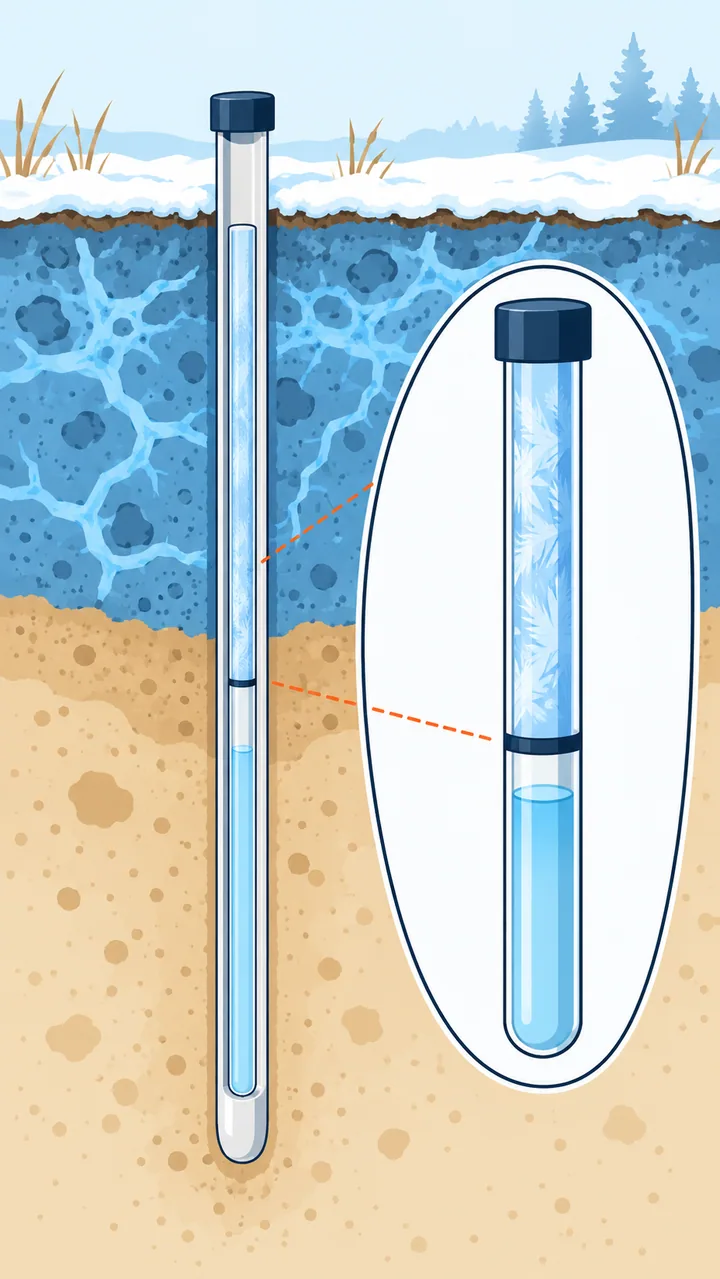
- Frost tubeClear ice vs coloured liquidThe boundary marks the frozen depth. USGS.
- Tube lengthPast the frost, plus about 1 mSticks above snow cover. UAF guide.
- Infrared thermometerSurface onlyIt cannot see below the surface.
How Is Frost Depth Measured?
Frost depth is measured with a frost tube or with soil temperature sensors at several depths. A frost tube shows frozen ground by colour. Sensors show it by temperature, where the frozen part is at or below 32 °F. Weather and research networks use both.
Which Method Should You Use?
| Method | How it shows frost | Strengths | Limits |
|---|---|---|---|
| Frost tube | Clear ice vs coloured liquid in a buried tube | Cheap, direct, reversible | Must be read by hand |
| Soil temperature sensors | Depth where soil is at 32 °F | Logs remotely, used by state networks | Interpolates between sensors; can read shallower than a frost probe |
| Infrared thermometer | Surface temperature only | Instant | Cannot see below the surface |
A two-year Weather Service review found a liquid-in frost probe tracked soil temperature data closely but consistently showed deeper frost.
How Does a Frost Tube Work?
A frost tube holds water with a dye, and freezing separates the two. A USGS description says the tubes are filled with a dilute methylene blue solution, and on freezing the dye remains in the liquid, so the ice is clear and marks the depth of soil frost. The maker Smartec adds that the effect is reversible, so thaw can be followed too.
A Japanese comparison with direct soil observation reported an error of about 0.035 m, with thaw depths read slightly deeper by the tube.
How to Make and Install a Frost Tube
The University of Alaska Fairbanks guide builds a tube with three layers.
- Seal a length of clear tubing at both ends and fill it with coloured water. This is the inner tube.
- Slide it into a middle tube of radiant heat tubing sealed at the bottom.
- Place both inside an outer CPVC pipe, open at the bottom, with a removable cap on top.
- Make the tube a little longer than the depth the ground freezes, plus about 1 m so the top clears the snow.
- Mark every 10 cm so you can read it with a meter stick.
- Pull the inner tube to read where clear ice meets coloured liquid.
The guide uses food colouring, not methylene blue. Commercial probes use a pulling bar to lift the inner tube.
How Do Soil Temperature Sensors Measure Frost?
Sensors are buried at set depths and log temperature. The deepest sensor at or below 32 °F gives the frozen depth, and you can read it remotely. This is how many state weather networks report soil conditions. Water in soil can freeze slightly below 32 °F, so sensor results are estimates between sensor depths.
Can You Measure Frost Depth With a Temperature Gun?
No. An infrared thermometer reads the surface it points at, not the soil below it. To find frost at depth you need a probe in the ground, a sensor, or a hole.
Where Can You Find Official Frost Depth Readings?
Look at state weather networks and the National Weather Service. See current frost depth for a list of sources.
How Is Frost Depth Calculated Without Measuring?
Engineers estimate it from air temperature, snow, and soil properties, and codes summarise the result as the frost line. See frost penetration depth.
Is Frost Depth Measured to the Top or Bottom of the Footing?
To the bottom. The IRC tells jurisdictions to give the minimum depth of footing below finish grade (Table R301.2, footnote b). The bottom of the footing must reach that depth.
Should You Measure Frost Depth Before Building?
No. Build to the code frost line, since that is what the inspector checks. A measurement from one winter can be shallower than a harder winter, so it is no basis for a footing. Enter your ZIP code for the depth that applies.
Questions People Ask
How is frost depth measured?
With a frost tube pushed into the ground, or with temperature sensors buried at several depths. The frozen depth is where the ground reaches 32 °F.
Can you measure frost depth with a temperature gun?
No. An infrared thermometer reads the temperature of the surface it points at, so it cannot tell you how deep the ground is frozen.
Do I need to measure frost depth before building?
No. Use the code frost line for your site, which the inspector enforces. A measurement describes one winter.
What Is Your Frost Line Depth?
Enter a ZIP code or city to see the depth your own building code sets.