
IRC Frost Depth Requirements
The International Residential Code does not set a frost depth number. Each jurisdiction fills it into Table R301.2. The IRC does require footings at least 12 inches below undisturbed ground and frost protection by one of four methods, with exceptions for small accessory buildings and free-standing decks. This page walks through each provision for the 2018, 2021 and 2024 editions.
- Checked October 2026
- 5 sources
- How we verify
- Minimum footing depth12 inBelow undisturbed ground. R403.1.4.
- Frost protection methods4Below the frost line, FPSF, ASCE 32, or rock. R403.1.4.1.
- Accessory building exemption600 sq ft light-frameEave height 10 ft or less. 400 sq ft if not light-frame.
What Does the IRC Require for Frost Depth?
The IRC requires exterior footings to sit at least 12 inches below the undisturbed ground surface and to be protected from frost by one of four methods. It does not give a frost depth. That number belongs to the jurisdiction, which fills it into Table R301.2. Your local code may differ from the model code, so confirm it with your building department.
Is There a Frost Line Depth Table in the IRC?
Not with numbers. Table R301.2 (Table R301.2(1) in the 2018 edition) is a form that lists climate and geographic design criteria, including a frost line depth column, and the jurisdiction completes it. Footnote b says the jurisdiction shall fill in the frost line depth column with the minimum depth of footing below finish grade. So the code’s frost line is a legal minimum footing depth, not a measurement.
The same table lists ground snow load, wind, seismic category and the air freezing index. See ground snow load.
What Is the Minimum Footing Depth in the IRC?
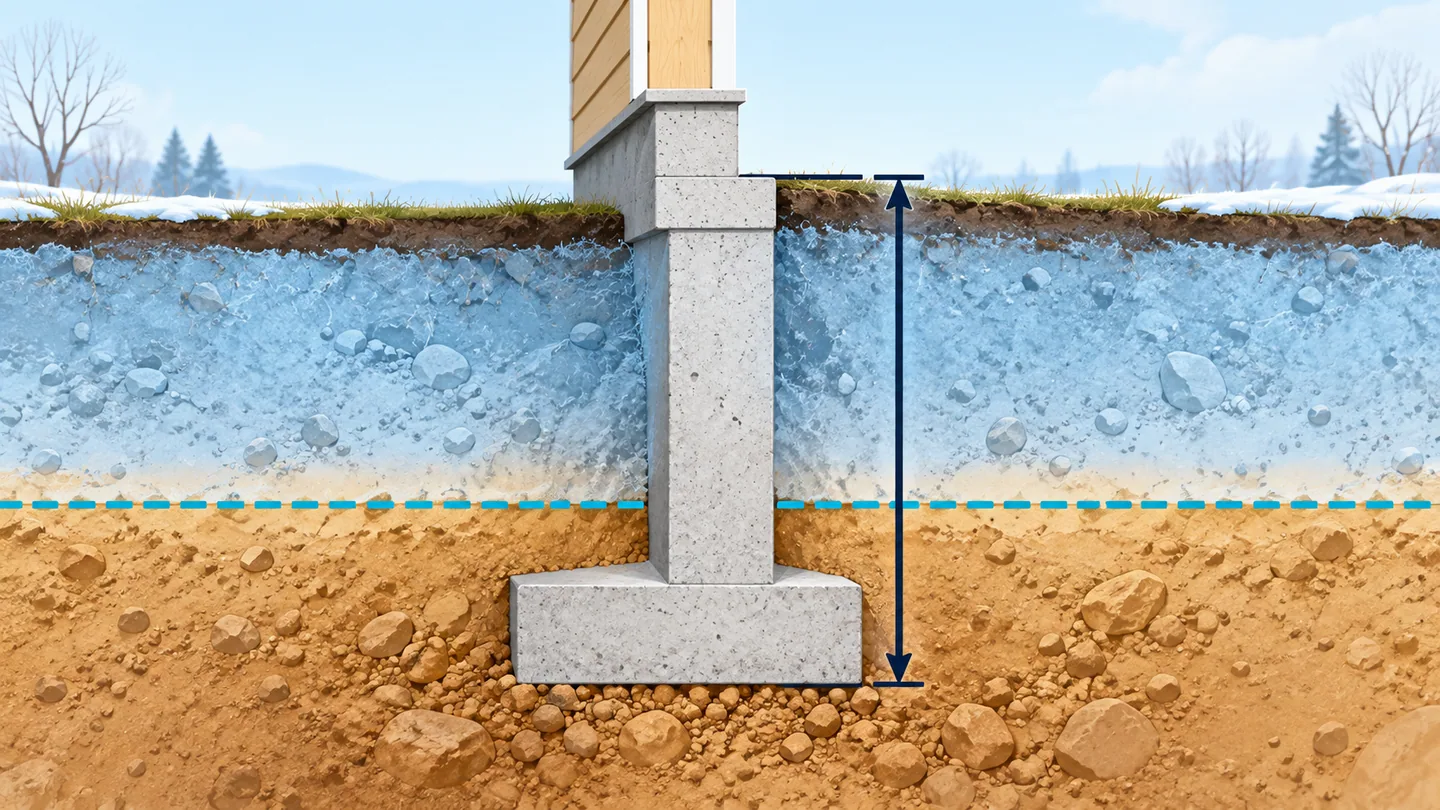
Twelve inches. R403.1.4 requires exterior footings to extend at least 12 inches below the undisturbed ground surface, even where frost never reaches that deep. The 2021 and 2024 editions add that deck footings follow Section R507.3.
What Are the Four Ways to Protect Footings From Frost?
Section R403.1.4.1 protects foundation walls, piers and other permanent supports by one or more of these:
- Extending below the frost line in Table R301.2.
- A frost-protected shallow foundation under R403.3.
- Construction to ASCE 32.
- Erecting on solid rock.
The section also says footings shall not bear on frozen soil unless the frozen condition is permanent.
Which Structures Are Exempt?
Free-standing accessory structures are exempt from frost protection when they are small:
- Light-frame, 600 square feet or less, eave height 10 feet or less.
- Not light-frame, 400 square feet or less, eave height 10 feet or less.
Decks have their own rules in R507.3. In the 2021 and 2024 editions, frost protection applies where a deck is attached to a frost-protected structure. See deck footing depth and shed footing depth. Local amendments may be stricter. Minnesota, for one, handles slabs differently.
What Are the IRC Rules for Frost-Protected Shallow Foundations?
R403.3 lets footings stay shallow for buildings kept at a monthly mean temperature of at least 64 °F when insulated to Figure and Table R403.3(1). Insulation must meet ASTM C578. It does not apply to unheated spaces. Read the full guide at frost-protected shallow foundations.
How Have the IRC Frost Rules Changed Between Editions?
The four methods and the exemptions for small accessory buildings are the same in 2018, 2021 and 2024. The main change is for decks.
| 2018 | 2021 and 2024 | |
|---|---|---|
| Footing depth rule | R403.1.4, with R403.1.4.1 and R403.1.4.2 | R403.1.4, deck footings per R507.3 |
| Free-standing decks | Need not extend below the frost line | At least 12 in deep, frost depth only where attached to a frost-protected structure |
| Footing size table | R507.3.1 | R507.3.1, 2021 version with 40 to 70 psf loads |
What Are the Frost Rules for Water and Sewer Lines in the IRC?
Section P2603.5 says where the winter design temperature is 32 °F or lower, pipes may not be installed where they are subject to freezing unless protected. Water service pipe goes at least 12 inches deep and at least 6 inches below the frost line. Sewer depth is left blank for each jurisdiction. See water line depth and sewer line depth.
How Do States Change the IRC Frost Rules?
States adopt the IRC with amendments and set their own numbers. Examples we verified: Minnesota sets 42 or 60 inches by zone, Massachusetts 48 inches and Rhode Island 40 inches. Pick your state from the frost line list or enter your ZIP code.
Questions People Ask
What does the IRC require for frost depth?
The IRC requires exterior footings at least 12 inches below undisturbed ground and protected from frost by extending below the frost line, a frost-protected shallow foundation, ASCE 32, or solid rock. The frost line number comes from your jurisdiction.
Is there a frost line map in the IRC?
There is no frost depth map that sets a code number. Table R301.2 has a column the jurisdiction fills in. The IRC does print an air freezing index map for frost-protected shallow foundations.
Do states change the IRC frost rules?
Yes. States and localities amend the IRC and set their own depths. Minnesota, for instance, sets 42 or 60 inches by zone and Massachusetts 48 inches.
What Is Your Frost Line Depth?
Enter a ZIP code or city to see the depth your own building code sets.