
What Is Frost Heave?
Frost heave lifts the ground, and anything built on it, when water in fine soil freezes into growing layers of ice. It needs three things at once: freezing weather, frost-susceptible soil and a water supply. This page explains how it works, which soils are at risk, why fence posts and footings get pushed up, and how depth, drainage and backfill prevent it.
- Checked October 2026
- 4 sources
- How we verify
- Needs all threeCold, fine soil, waterRemove any one and heave stops.
- Most susceptible soilSiltClay and fine sand can heave too.
- Susceptibility test10% finer than 0.075 mmA common agency rule for frost-susceptible material.
What Does Frost Heave Do to the Ground?
Frost heave is the upward movement of the ground, and whatever sits in it, caused by ice forming in the soil. Water drawn toward the freezing front collects as ice lenses, which grow and push the soil up. A footing, post or slab in that soil rises with it.
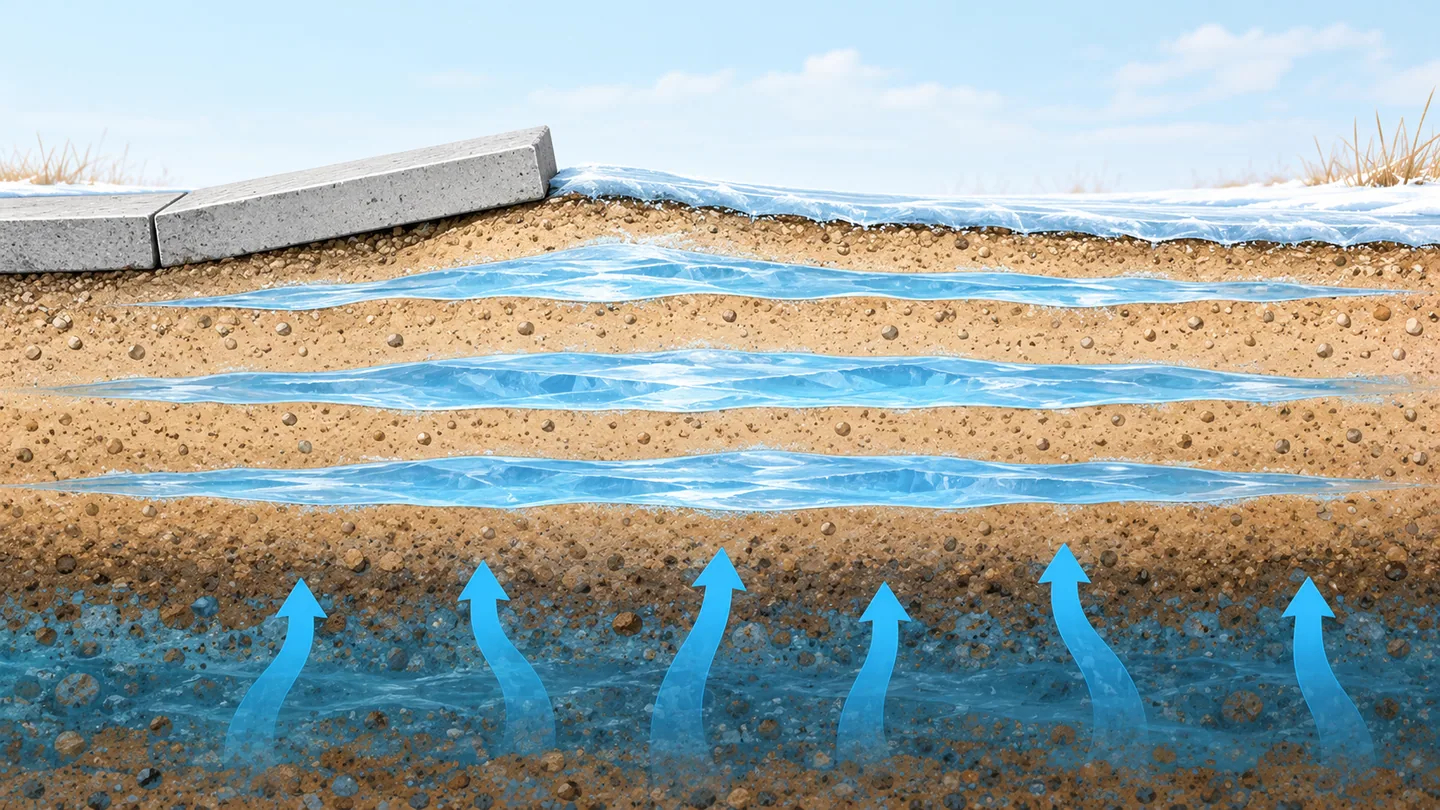
What Causes Frost Heave?
Three conditions must be present together:
- Sustained freezing. Temperatures stay below freezing long enough for the freezing front to move down.
- Frost-susceptible soil. Soil with many fine particles, usually silt-sized.
- Access to water. A steady supply, often a high water table or wet ground.
Because all three are needed, removing any one prevents heave.
| Condition | What it looks like | How builders remove it |
|---|---|---|
| Sustained freezing | Frost reaching the footing | Go below the frost line, or insulate (FPSF) |
| Frost-susceptible soil | Silt or other soil with many fines | Clean gravel backfill around posts and footings |
| Water supply | Wet ground or a high water table | Grading, drainage and gutters that carry water away |
Which Soils Are Most Susceptible to Frost Heave?
Silts are the classic problem soil, and the more fines a soil holds, the more susceptible it is. Many agencies classify material as frost susceptible when 10 percent or more passes the 0.075 mm (No. 200) sieve. Coarse sand and gravel mostly resist heave. Even so, clay and very fine sand can support ice lenses. See clay soil and frost and gravel and frost.
How Deep Does Frost Heave Happen?
Heave happens within the frozen zone, where ice forms. Highway references note that a water table up to about 10 feet down can still supply enough water for significant heave, so the water source can lie below the frost itself. A footing that reaches below the frost line avoids the problem because the soil around it never freezes.
Why Do Fence Posts and Deck Footings Heave?
The frozen soil grips the sides of a post or footing and lifts it as the ground rises. A shallow post has little below the frost to hold it down, so it jacks up a little each winter. Footings that sit on frozen soil or above the frost line are the usual ones. The IRC says footings shall not bear on frozen soil unless the frozen condition is permanent (R403.1.4.1). See fence post depth and deck footing depth.
How Do You Prevent Frost Heave?
Remove one of the three conditions. In practice:
- Go below the frost line with the footing bottom (the footing depth guide).
- Use frost-protected shallow foundation insulation to keep ground from freezing.
- Drain the site so water cannot collect around the footing.
- Use non-susceptible backfill, such as clean gravel, around posts and footings.
- Build on solid rock where it is available.
Will Frost Heave Go Back Down?
Partly. Spring thaw melts the ice and the ground settles, but it often does not settle evenly. Thawing leaves soil wet and soft, and repeated cycles can leave a post or slab higher or tilted than it started.
How Do Frost-Protected Shallow Foundations Stop Heave?
They stop the freezing instead of going below it. Rigid insulation traps heat from the building and the earth so the soil under a shallow footing stays above freezing. See what a frost-protected shallow foundation is.
Questions People Ask
Will frost heave go back down?
Partly. When the ice thaws in spring the ground settles, but it often does not return to exactly where it was, and thawing leaves soil wet and weak. Repeated cycles can leave a post or slab higher or tilted.
How deep does frost heave happen?
Only within the frozen zone, and only where the soil is susceptible and water can reach it. A footing below the frost line sits in unfrozen soil, so ice cannot form around it.
Can clay soil heave?
Yes. Silt is the classic problem soil, but heave can also occur in clay and sandy soils when water and cold conditions are right.
What Is Your Frost Line Depth?
Enter a ZIP code or city to see the depth your own building code sets.