
Does Gravel Reduce Frost Depth?
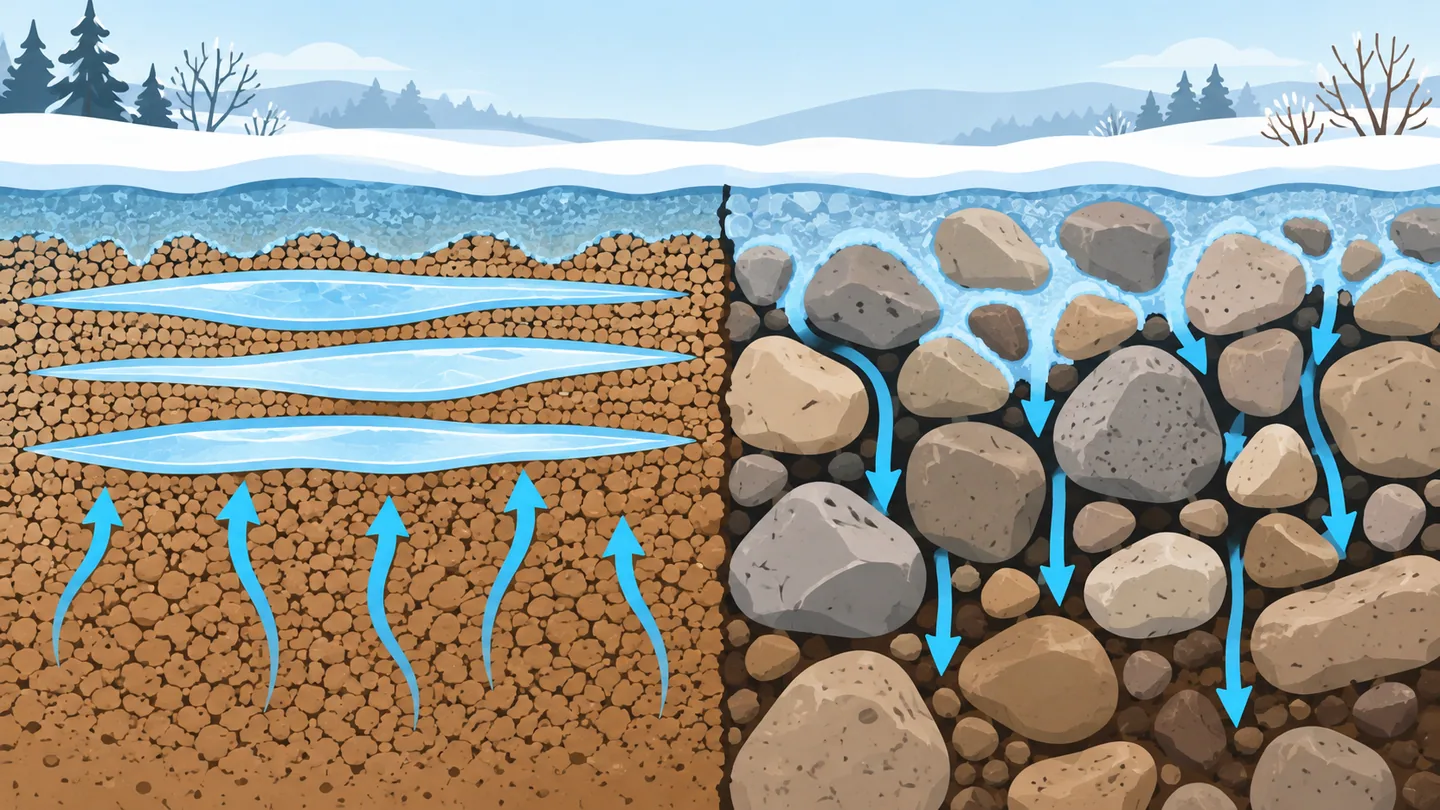
Gravel does not keep frost out of the ground. Frost often goes deeper in dry, coarse gravel than in wet soil, because there is little water to slow the freezing. What gravel does well is drain water away, so the ground under slabs, pavers and posts heaves less. Footings still have to reach the frost line.
- Checked October 2026
- 3 sources
- How we verify
- Effect on frost depthNone to deeperDry coarse soil has little latent heat to slow frost.
- Effect on heaveLowerFree-draining, not frost-susceptible.
- Replaces a footingNoDig to the code frost line or use FPSF.
Does Gravel Keep Frost Out of the Ground?
No. Gravel does not stop frost from entering the ground, and dry coarse soil can freeze deeper than wet soil. What gravel changes is how much water is around, which affects heave. Your footing depth is still the code frost line.
Why Can Frost Go Deeper in Gravel?
Because it holds little water. As water freezes it releases latent heat, which slows the advance of frost. Wet soil has a lot of water doing that, and dry gravel has little. One source notes it takes 144 Btu to freeze a pound of water but only about 0.20 Btu to change a pound of dry soil by one degree. Moist soil also conducts heat better, so the two effects interact. A monitoring study of dry gravel in British Columbia recorded frost to 3.98 m in a hard winter.
How Do Gravel, Silt and Clay Compare?
| Soil | Water it holds | Frost depth tendency | Heave risk |
|---|---|---|---|
| Clean gravel | Little | Can freeze deep, with little water to slow it | Low: drains, few fines |
| Silt | A lot, and draws more in | Slowed by its water | Highest: the classic frost-susceptible soil |
| Clay | A lot, but water moves slowly | Slowed by its water | Can heave, often more slowly than silt |
The code frost line is the same for all three. See clay soil and frost and frost heave.
Why Does Gravel Reduce Frost Heave?
Heave needs frost-susceptible soil and water. Clean gravel has few fine particles and drains freely, so ice lenses do not have a steady water supply. Many agencies treat soil as frost susceptible when 10 percent or more passes the No. 200 sieve, and clean gravel falls well below that. See frost heave.
How Much Gravel Base Do Slabs and Pavers Need in Cold Climates?
Use what your local code or the slab designer specifies. We did not find a single national gravel depth, so we do not give one. Whatever the thickness, the base should be compacted, clean, free-draining, and sloped so water leaves it. Slab details are on slab-on-grade frost line.
Can Gravel Backfill Replace a Footing Below the Frost Line?
No. The IRC protects footings from frost by going below the frost line, using a frost-protected shallow foundation, following ASCE 32, or building on rock (R403.1.4.1). A gravel layer is not one of those methods. Gravel around a post can help limit grip from frozen soil, but it does not replace depth. See fence post depth.
What Happens If You Do Not Put Gravel Under Concrete?
Concrete on wet, fine soil sits on ground that holds water, so it is more exposed to heave and settling. A compacted, draining base reduces that water. For a slab attached to a house, the structure design controls what base is required.
Questions People Ask
Can gravel backfill replace a footing below the frost line?
No. Gravel can reduce heave next to a post, but the footing still has to reach the code frost line or use an approved method such as a frost-protected shallow foundation.
What happens if you do not put gravel under concrete?
Concrete on wet, fine soil is more exposed to heave and settling. A compacted, draining gravel base reduces the water that heaves it. The amount is set by your local code or the slab designer.
Why can frost go deeper in gravel?
Gravel holds little water. Water in soil absorbs heat when it freezes, so a drier soil has less to slow the freezing front, and frost moves down faster.
What Is Your Frost Line Depth?
Enter a ZIP code or city to see the depth your own building code sets.