
How Cold Is the Ground Below the Frost Line?
Below the frost line the ground stays above freezing all winter. Deeper down, soil temperature changes less and less with the seasons and settles near the area's average yearly temperature. This page explains how temperature changes with depth, what that means for buried water lines, and how to estimate the deep-ground temperature for your area.
- Checked October 2026
- 3 sources
- How we verify
- Below the frost lineAbove 32 °FBy definition of the frost line.
- Swing at 10 ftAbout ±6 °FFrom about ±11 °F at the surface. MSU Extension.
- Deep groundNear 30 ftRoughly steady year round. A rule of thumb.
What Is the Temperature Below the Frost Line?
Below the frost line the soil stays above 32 °F through the winter. That is what the frost line means. How far above depends on where you live and how deep you go. There is no single national value.
How Does Soil Temperature Change With Depth?
Seasonal swings shrink and lag as you go down. Soil has high heat capacity, so winter and summer reach depth slowly and weakly. A Michigan State University Extension bulletin reports about ±11 °F annual swing at the surface, reduced to about ±6 °F at 10 feet. Soil at 10 to 12 feet may not peak until almost three months after the surface.
Sandy and very moist soils show larger swings at depth than clay or dry soil.
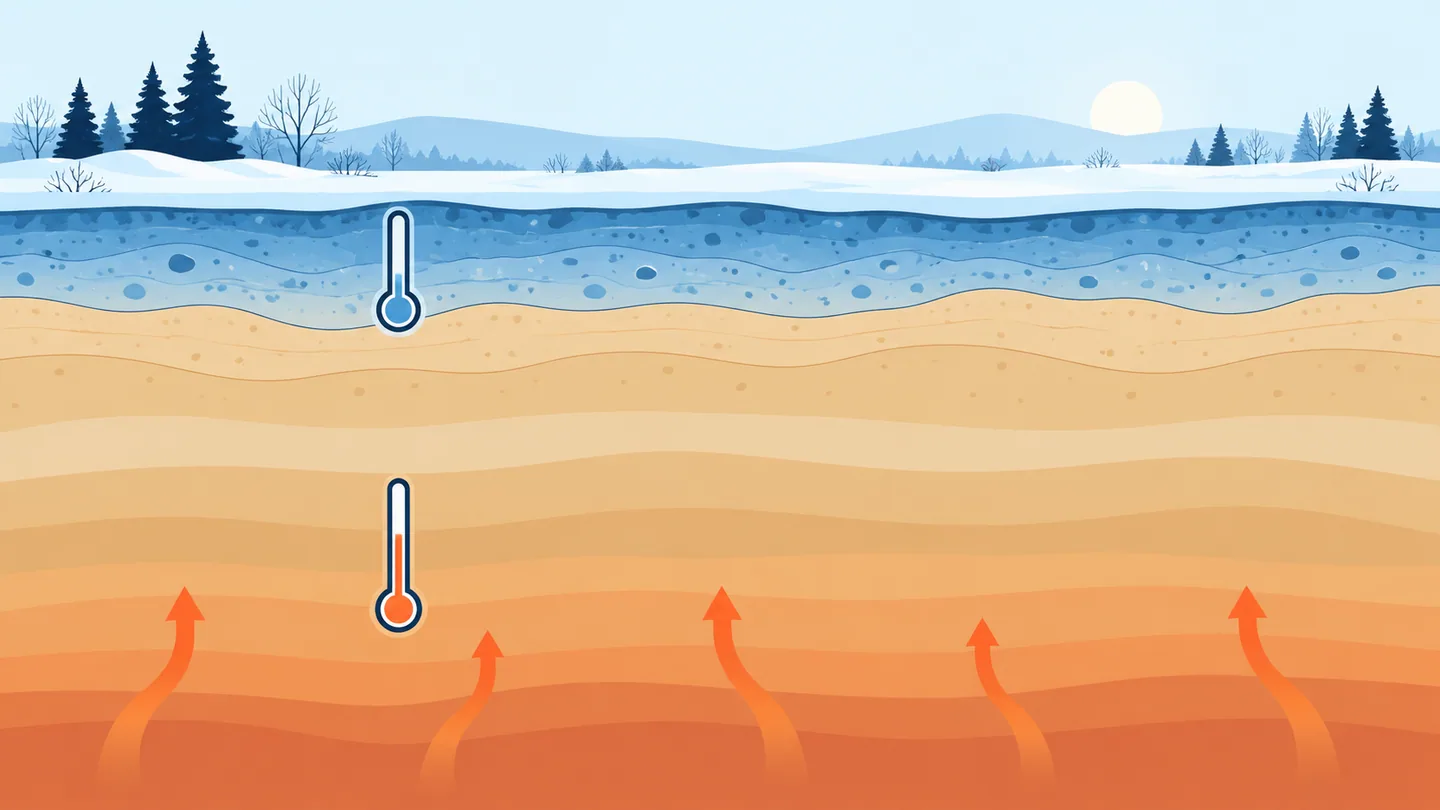
| Depth | Seasonal swing | What changes |
|---|---|---|
| Surface | About ±11 °F a year | Follows the weather closely |
| 10 ft | About ±6 °F a year | Peaks up to about three months after the surface |
| About 30 ft | Roughly steady | Near the local average yearly temperature (rule of thumb) |
Swings are from a Michigan State University Extension bulletin; the 30 ft figure is a general guideline, not a sharp cutoff.
How Cold Is It 20 Feet Underground?
Close to the area’s average yearly temperature, with a small seasonal swing. One guide treats about 30 feet as the depth where soil temperature stays roughly constant through the year, and says it matches well water temperature in wells 30 to 50 feet deep. Treat 30 feet as a rule of thumb, not a sharp line. Use local ground-temperature data for design.
What Is the Average Ground Temperature Where You Live?
The average yearly air temperature is a reasonable first estimate of deep ground temperature, within a degree or so in many places, though surface cover can shift it. Look up your station’s annual mean from NOAA climate normals and label it an estimate.
Why Do Buried Water Lines Go Below the Frost Line?
So the water inside never reaches freezing. The IRC puts water service pipe at least 12 inches deep and at least 6 inches below the frost line (P2603.5). Lines that cannot go that deep need insulation. See water line depth.
How Long Does It Take the Ground to Freeze?
Frost builds from the surface down through winter, not in a single cold night. The pace depends on how cold the air is and for how long, how much snow covers the ground, and how wet the soil is.
Is the Temperature Below the Frost Line the Same Everywhere?
No. Deep-ground temperature follows the local average yearly temperature, which varies widely across the country. A warm southern site and a cold northern site can differ by tens of degrees at the same depth. Look up your frost line for the depth that applies to you.
Questions People Ask
What is the temperature below the frost line?
Above freezing, and steadier the deeper you go. There is no single national number, since deep-ground temperature follows the local average yearly air temperature.
How cold is it 20 feet underground?
Close to your area's average yearly temperature, with only a small seasonal swing. The exact figure varies by climate and soil, so use local data.
How long does it take the ground to freeze?
It depends on how cold the air gets and for how long, the snow, and the soil. Frost builds gradually through winter, not overnight.
What Is Your Frost Line Depth?
Enter a ZIP code or city to see the depth your own building code sets.