
How Deep Are Sewer Lines Buried?
Building sewer depth is set by your local code. The International Residential Code leaves the number blank for each jurisdiction to fill in, and the line's required slope usually decides how deep it ends up. This page covers local minimums, slope rules, freeze protection, and whether water and sewer lines can share a trench.
- Checked October 2026
- 3 sources
- How we verify
- IRC sewer depthSet locallyP2603.5.1 has two blanks, each filled in by the jurisdiction.
- Slope, pipe 2.5 in or smaller¼ in per footIRC Table P3005.3, as quoted in secondary sources.
- Slope, pipe 3 to 6 in⅛ in per footSame table. Check your adopted edition.
What Does the IRC Say About Sewer Depth?
Sewer lines are buried as deep as the local code says, and the International Residential Code leaves the number to each jurisdiction. P2603.5.1 reads “not less than [NUMBER] inches” in two places, one for the building sewer at the septic tank connection and one for building sewers generally.
So there is no national sewer depth. In practice the sewer’s slope and the height of the house’s outlet decide how deep it ends up. Look up your frost line depth to see your authority, then ask it for the sewer depth.
Who Sets the Minimum Sewer Depth?
Your local jurisdiction sets it, by filling in the two blanks in P2603.5.1 of its adopted plumbing code. Some do, and many do not, so a lot of places leave the depth to the plumber’s design and the slope rule.
Ask your building or plumbing department for its adopted amendments. If the number is blank, the sewer still must meet the slope rule and protect against freezing.
How Much Slope Does a Sewer Line Need?
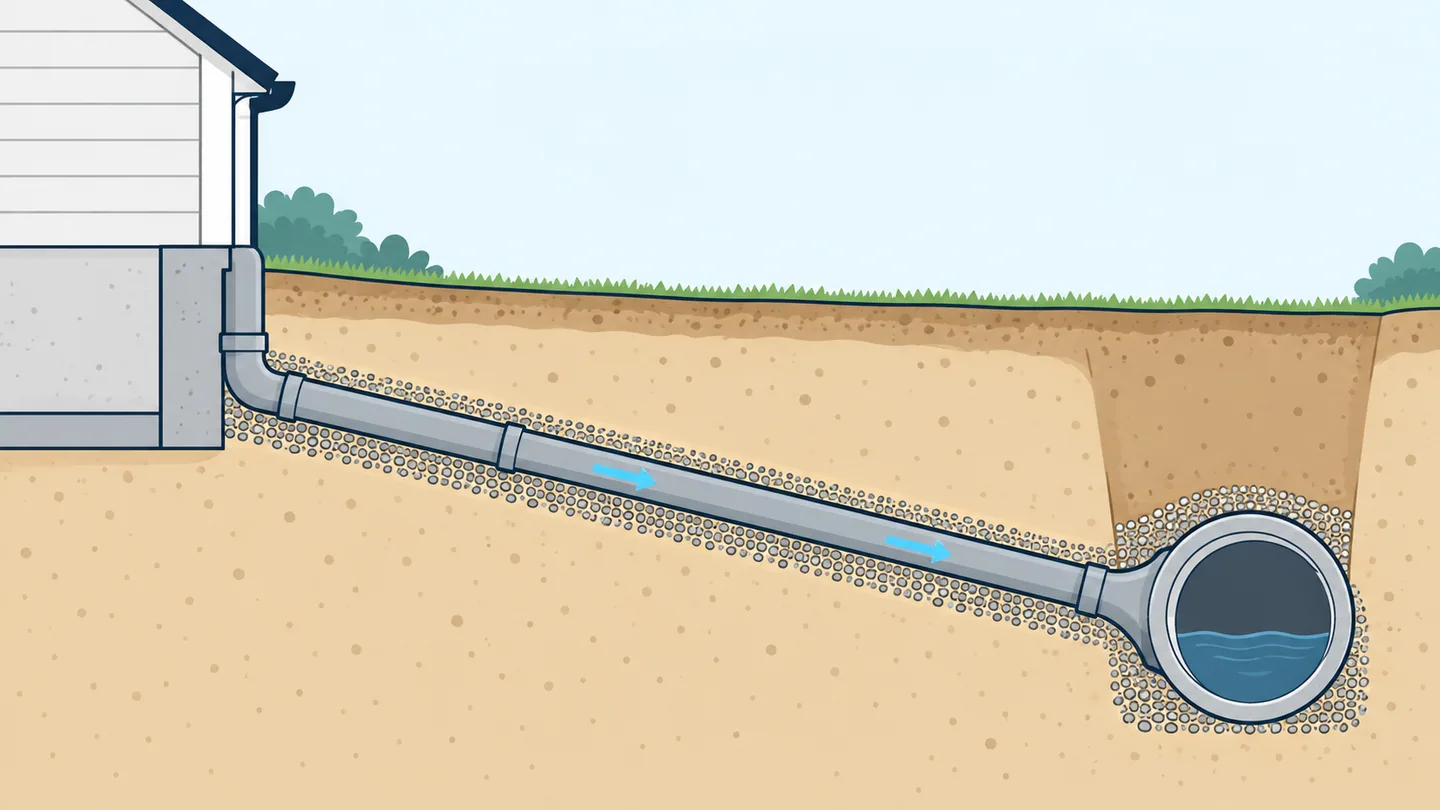
A sewer line needs a continuous downward slope: ¼ inch per foot for pipe 2½ inches or smaller, and ⅛ inch per foot for pipe 3 to 6 inches, according to Table P3005.3 of the IRC as quoted in secondary sources. Building sewers are typically 4 inches, so ⅛ inch per foot is the usual figure.
| Pipe diameter | Minimum slope |
|---|---|
| 2½ in or smaller | ¼ in per foot (2 percent) |
| 3 to 6 in | ⅛ in per foot (1 percent) |
Over a 50 foot run, ⅛ inch per foot drops the pipe 6¼ inches. That is why a sewer that must leave a deep outlet or reach a distant main can end up deeper than any frost rule requires. Confirm the table in your adopted edition.
Do Sewer Lines Need to Be Below the Frost Line?
The IRC does not tie sewer depth to the frost line, but it does say pipes may not be installed where they can freeze unless protected, in P2603.5. Sewers carry warm household water, but a line that stands empty between uses can freeze in a shallow, exposed run, such as under a driveway.
A sewer buried below the frost line avoids the question, and insulation or heat is the code’s other way to protect a pipe. Which one your inspector accepts is local. See water line depth for the supply-line rule.
Can Water and Sewer Lines Be Buried in the Same Trench?
Yes, under certain conditions. IRC P2604.2 sends you to P2906.4.1. If the building sewer is made of materials listed in Table P3002.1(2), the two lines may share a trench. If not, the water service and the sewer must be separated horizontally by at least 5 feet of undisturbed or compacted earth.
- Crossings. The separation does not apply where a water service crosses a sewer, if the water service is sleeved 5 feet horizontally on each side of the crossing.
- Elevation. It also does not apply where the bottom of the water service, within 5 feet of the sewer, is at least 12 inches above the highest point of the sewer.
The trench must also give each pipe solid, continuous support, never rocks or blocks (P2604.1).
How Deep Are City Sewer Mains Compared With House Laterals?
City sewer mains are set by the sewer utility’s own standard and are often deeper than a house lateral, because they collect from many lines. The utility owns the main and sets its depth, and your lateral connects to it at whatever depth it lies.
Ask the utility for the depth of the main at your connection point before you design the lateral. See buried utility depth for other lines.
What Happens When a Sewer Line Freezes?
A frozen sewer line backs up, usually at the weakest point: a shallow section, a sag, or the place where the pipe leaves the house. A sag holds water that can freeze, and the wastewater behind it has nowhere to go.
Thaw it with a plumber’s help, then fix the cause, which is usually depth, slope or a low spot. Septic systems freeze in similar places; see septic and the frost line.
Questions People Ask
How deep are sewer lines buried?
As deep as your local code says. The IRC leaves a blank for each jurisdiction to fill in for building sewers. In practice the required slope and the depth of the house's outlet decide the depth, and cold places add freeze protection.
Can water and sewer lines be in the same trench?
Under the IRC, yes, if the sewer uses approved materials, or if the water service stays 5 feet away horizontally, or sits at least 12 inches above the top of the sewer. A crossing needs a sleeve.
What Is Your Frost Line Depth?
Enter a ZIP code or city to see the depth your own building code sets.