
How Do You Insulate a Buried Water Line?
The building code's main protection for a buried water line is depth: at least 12 inches deep and 6 inches below the frost line. Insulation helps where a line cannot go deep enough, such as under driveways, near foundations or on rocky ground. This page explains the code rule, which insulation works underground, how to lay foam board over a trench, and when you need approval to bury a line shallower.
- Checked October 2026
- 3 sources
- How we verify
- Code depth, water service12 in deep, 6 in below frostIRC P2603.5. Insulation is the add-on, not the default.
- Insulation tested for frost shieldsExtruded polystyreneCRREL chose XPS for a New Hampshire water line: tough, light, resists moisture.
- Foam placementOver the pipe, not beside itPractitioner and engineering sources agree; foam should be wider than the trench.
Should You Insulate a Buried Water Line?
You should insulate a buried water line where it cannot go below the frost line, and you do not need to where it does. The code’s protection is depth: at least 12 inches deep and at least 6 inches below the frost line. Insulation is an add-on, or an approved alternative.
Common places where depth falls short are under driveways and walks, close to a foundation, and over ledge or rock. Look up your frost line depth and compare it to your trench.
What Does the Code Require for Water Line Depth?
IRC P2603.5 requires a water service pipe to be installed at least 12 inches (305 mm) deep and at least 6 inches (152 mm) below the frost line. The same section says that where the winter design temperature is 32 °F or lower, a pipe may not sit where it can freeze unless adequate provision is made to protect it from freezing by insulation or heat or both.
The first sentence is the depth rule. The second is the general rule for pipes in exterior walls, attics, crawl spaces and other exposed places. Whether insulation can substitute for depth on a buried line is for your building official to say. Water line depth has the full rule.
What Insulation Works Best Underground?
Closed-cell rigid foam board, usually extruded polystyrene (XPS), works best underground because it resists moisture. The US Army’s CRREL frost-shield study chose XPS for a New Hampshire water line for that reason, and cites it as tough, lightweight and easy to cut.
| Material | Underground? | Note |
|---|---|---|
| Extruded polystyrene board (XPS) | Yes | Moisture resistant; designers derate its R-value over the years |
| Dense expanded polystyrene (EPS) | Often | Check the maker’s moisture rating |
| Fiberglass wrap | No | Loses its value when wet |
| Pipe sleeve foam alone | Weak | Does little when the ground is wet or compacted |
Designers of frost-protected foundations derate XPS from its nominal R-5 per inch to R-4.5 per inch to allow for performance loss after years in the ground. That is a foundation practice, and the same caution applies to a buried pipe.
How Do You Insulate an Underground Water Pipe?
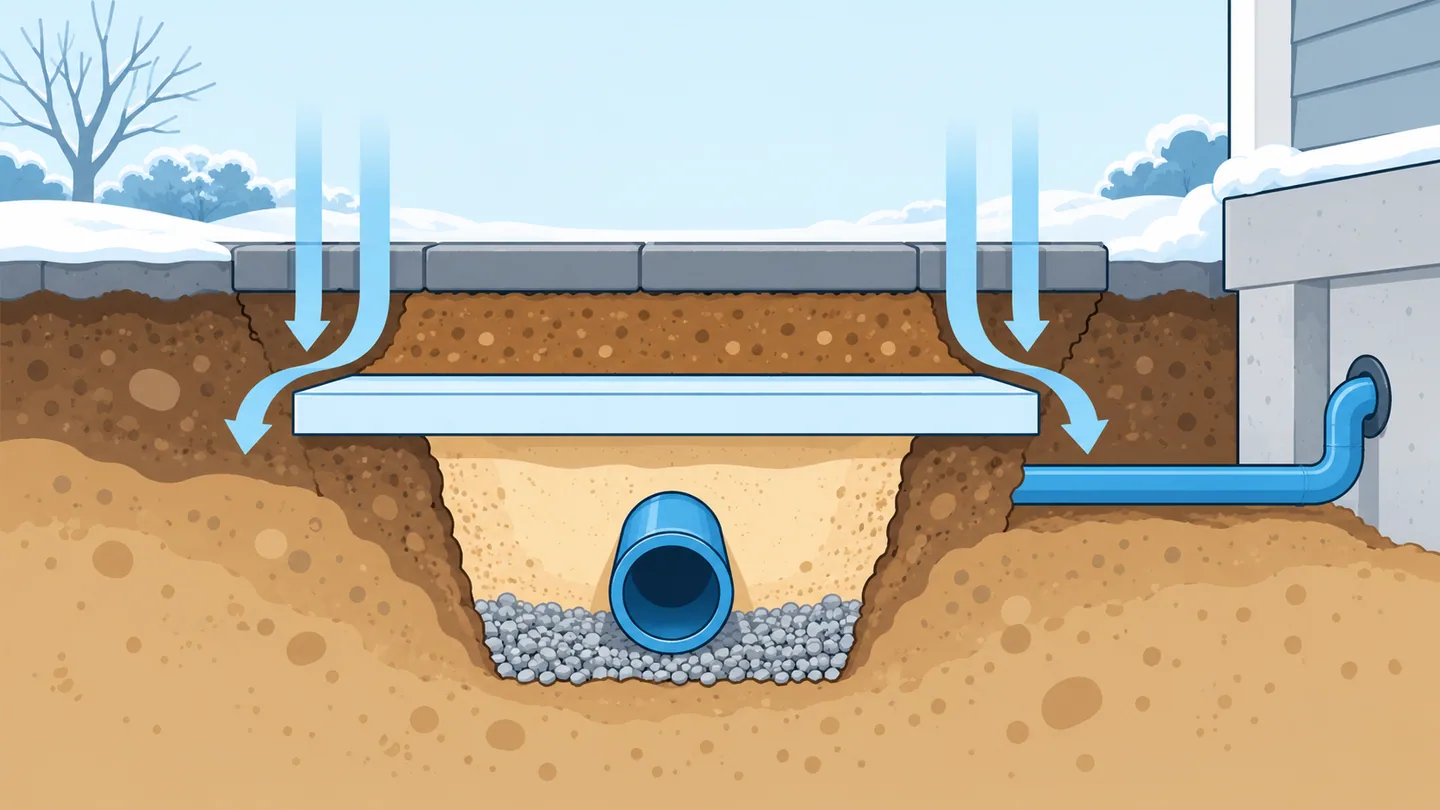
Lay the pipe on a good bed, then place foam board over it, wider than the trench.
- Call 811 before you dig.
- Dig the trench as deep as you can. Even a partial depth helps.
- Bed the pipe on continuous, solid support, with no rocks or blocks beneath it (IRC P2604.1).
- Cover the pipe with a few inches of soil or sand.
- Lay XPS board horizontally above the pipe, several feet wide so it traps the heat rising from the ground below it. Foam beside the pipe helps less than foam above it.
- Protect the board with soil that cannot wash away. Erosion can expose it.
- Backfill and compact in layers.
The CRREL study used a computer heat-flow model to size its frost shield, and no published table gives a wing width for a house water line. For a design you can trust, use a heat-flow calculation for your local freezing conditions, or ask your water utility.
Can Insulation Let You Bury a Water Line Shallower?
Insulation can let you bury a line shallower only if your building official approves it. The IRC accepts protection by insulation or heat for pipes in places subject to freezing, but it states the depth requirement as a separate rule. Do not assume one replaces the other.
Ask your plumbing inspector in writing: how much shallower, which insulation, what width, and what thickness. A shortcut that fails the inspection means digging the line up.
When Should You Use Heat Tape on a Buried Line?
Heat tape belongs on a buried line only for a short shallow section, such as where it passes under a driveway or enters the house. Use a cable made for water pipe, installed as the maker directs, and ask your inspector whether your code allows it underground.
Heat tape needs power and a working thermostat, so it adds a failure point if the power goes out. Depth and foam board do not.
Why Do Buried Lines Freeze Under Driveways and Sidewalks?
Buried lines freeze under driveways and sidewalks because snow-free pavement lets frost go deeper than it does under a lawn with a snow blanket. Cleared surfaces lose heat faster, so frost can reach a pipe that is safe elsewhere.
That is why shallow crossings are the usual trouble spots. Frost penetration depth explains what controls how deep frost goes.
Questions People Ask
Should you insulate a buried water line?
Insulate it where it cannot go below the frost line, such as under a driveway, near a foundation or over ledge. Where you can bury it to the code depth, depth is the protection, and insulation is an extra.
What type of insulation is best for underground pipes?
Closed-cell rigid foam, usually extruded polystyrene, laid as board above the pipe. The US Army CRREL report on frost shields chose XPS because it resists moisture. Fiberglass wrap loses its value when wet.
Can insulation let me bury a water line shallower than the code says?
Only with approval. The IRC says protection by insulation or heat is acceptable for pipes subject to freezing, but your building official decides whether it lets you reduce the burial depth. Get it in writing before you dig.
What Is Your Frost Line Depth?
Enter a ZIP code or city to see the depth your own building code sets.