
How Deep Should Irrigation Lines Be Buried?
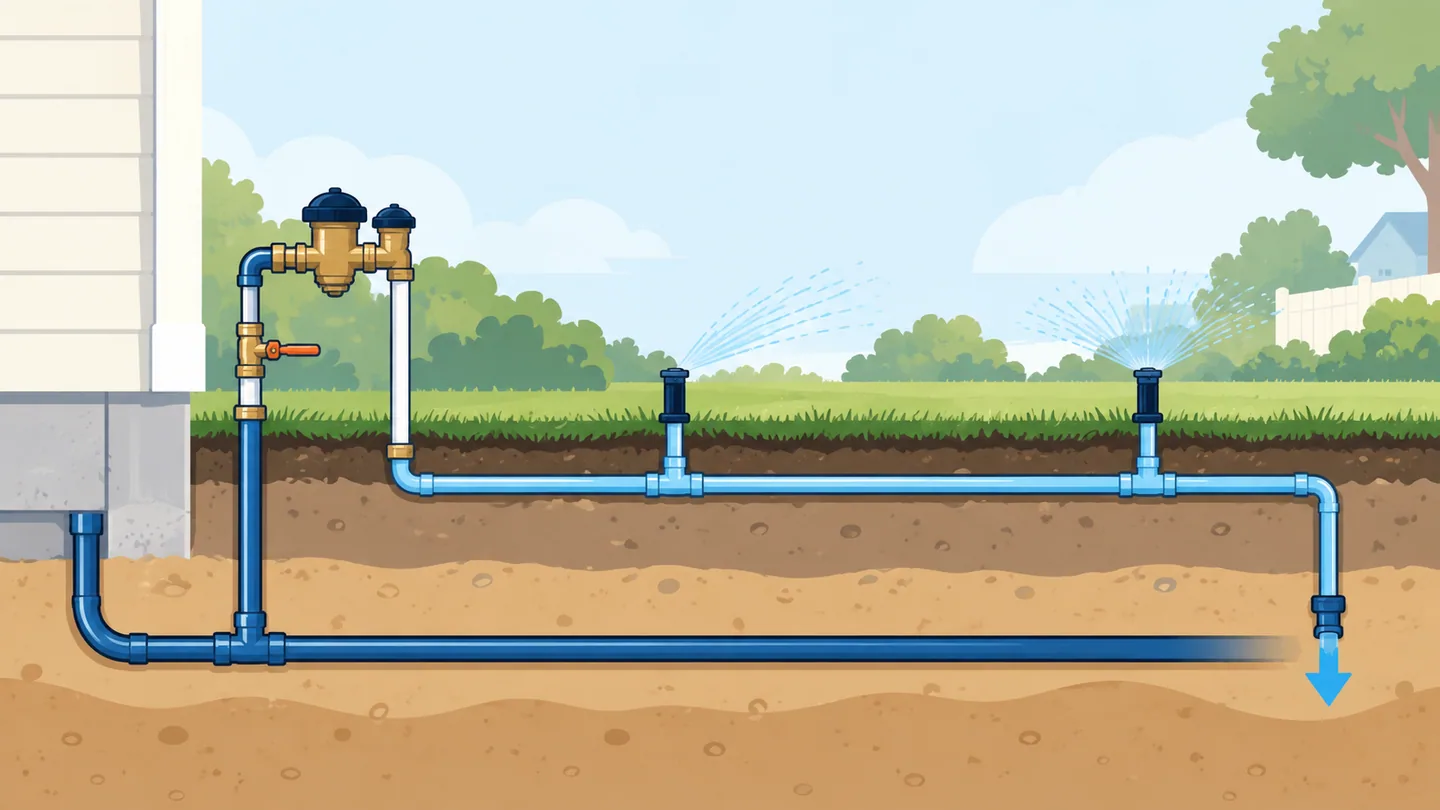
Sprinkler laterals are usually buried shallow, around 8 to 12 inches, and drained or blown out before winter instead of being set below the frost line. The pressurized supply line from the house is treated like a water service. This page gives typical depths for mains and laterals, how to winterize with compressed air, and what changes in warm climates.
- Checked October 2026
- 4 sources
- How we verify
- Sprinkler lines, Oregon State Extension8 to 12 inTypical burial for lateral and main sprinkler pipe. No national standard.
- Supply line from the houseWater service ruleAt least 12 in deep and 6 in below the frost line under the IRC, P2603.5.
- Blowout pressure50 psi or lessSeveral sources cap it there; Hunter's maximum is 80 psi. Stay under the lowest-rated part.
What Burial Depth Do Sprinkler Lines Need?
Irrigation lines are usually buried about 8 to 12 inches (20 to 30 cm) deep, which is the range Oregon State University Extension gives for sprinkler pipe. No national standard sets it, and local ordinances may apply. Pipe less than 6 inches deep risks cracking under vehicle weight or aeration.
The line from the house to the system is different. It is pressurized all winter, so it counts as a water service and follows the plumbing code. See the table.
| Line | Typical depth | Frost handling |
|---|---|---|
| Lateral pipe, to the heads | 8 to 12 in | Drained or blown out before winter |
| Main, valves to the zones | 8 to 12 in, deeper is common | Drained or blown out before winter |
| Supply from the house | 12 in minimum and 6 in below the frost line (IRC) | Buried below frost |
Irrigreen gives one rule of thumb for long runs, pipe diameter plus 4 inches, which is a minimum and not a target.
Do Irrigation Lines Need to Be Below the Frost Line?
Irrigation lines do not usually need to be below the frost line, because the water is removed before the ground freezes. Winterizing by compressed-air blowout works at the depths above. Oregon State Extension advises blowing lines out even at shallower depths.
Where the frost line reaches below your pipes, blowout is the best practice, and there are warm places where frost is not a worry at all. The pressurized supply line is the exception: look up your frost line depth and follow the water line depth rule for it.
How Deep Should the Irrigation Main Line Be?
The main line, between the supply and the zone valves, is commonly buried at the same 8 to 12 inches, and deeper where traffic crosses it. If part of the main stays under pressure through the winter, that part follows the supply-line rule: 12 inches deep and 6 inches below the frost line.
Drain the main with the rest of the system, and keep the manual or automatic drain valves at its low points. A main that holds water through a freeze can split.
How Do You Winterize Irrigation Lines?
Shut off the water, set the controller to off, and blow each zone out with compressed air before the first hard freeze.
- Shut off the water to the system at its supply valve.
- Set the controller to off and keep it plugged in. Some controllers restart if they lose power.
- Connect the compressor after the backflow device. Never blow compressed air through the backflow preventer.
- Set the air to 50 psi or less. Hunter says never to exceed 80 psi or the lowest-rated part in the system, and other trade sources cap it at 50 psi.
- Use enough volume. Hunter and Landscape Management cite a compressor of 80 to 100 cfm for a mainline of 2 inches or less. Volume matters more than pressure.
- Start at the zone farthest from the compressor and work back, running each zone until no water shows at the heads. Two or three short cycles per zone beat one long one.
- Open the drain valves at the low points, then close them again once the pipe is empty.
If you are unsure, hire a licensed irrigation contractor.
Does an Irrigation System Need a Backflow Preventer?
Most places require a backflow preventer on the irrigation supply, because irrigation water can be contaminated by fertilizer, soil and pesticides, and the device stops it from flowing back into the drinking water. The type, the location and the testing rules are local.
Ask your water utility or building department which device applies. It is also the part of the system you must protect from compressed air when you winterize.
What Happens if Irrigation Lines Freeze?
Irrigation lines that freeze while holding water can split pipes, fittings and heads. Water expands as it freezes, and rigid PVC and fittings crack. You find the damage in spring as a wet patch or a zone that will not hold pressure.
Prevention is cheap compared with repair: blow the system out each fall. In very cold places, a drain valve at the low point of every zone adds a second line of defense.
Questions People Ask
How deep do you bury water lines for an irrigation system?
Sprinkler pipe is commonly buried 8 to 12 inches deep, according to Oregon State University Extension. Pipe less than 6 inches deep risks cracking under vehicle weight, and the supply line from the house follows the plumbing code's water service depth.
Do irrigation lines need to be below the frost line?
Not usually. Lawn irrigation is drained or blown out before winter, so the water is gone when the ground freezes. The supply line from the house is a water service and does need to be below the frost line.
Does an irrigation system need a backflow preventer?
Most places require one on the supply line, and the type and the test rules are local. Hunter's winterizing guidance also warns never to blow compressed air through a backflow device.
What Is Your Frost Line Depth?
Enter a ZIP code or city to see the depth your own building code sets.