
Do Sheds Need Footings Below the Frost Line?
Most backyard sheds do not need frost-depth footings. The International Residential Code exempts free-standing light-frame accessory buildings up to 600 square feet with eaves no higher than 10 feet. Some states and counties set their own rules. This page explains the exemption, the local exceptions, foundation options from gravel pads to piers, how many piers a 10×12 or 12×16 shed needs, and when a permit applies.
- Checked October 2026
- 5 sources
- How we verify
- Light-frame shed, exempt600 sq ft or lessFree-standing, eave 10 ft or lower. IRC R403.1.4.1, same in 2018, 2021 and 2024.
- Not light-frame, exempt400 sq ft or lessFree-standing, eave 10 ft or lower.
- Permit exemption, IRC 2021200 sq ft or lessOne-story detached accessory structure. Local codes often set less.
What Does the IRC Say About Shed Footings and Frost?
A shed does not need footings below the frost line under the International Residential Code if it is free-standing, light-frame, 600 square feet or less, and has an eave height of 10 feet or lower. A shed that is not light-frame has a lower limit of 400 square feet. Both rules sit in R403.1.4.1.
Check your own code before you rely on this. A state or county can change the limits, and the rule does not cover a shed attached to another building. Look up your frost line depth to see which authority sets yours.
Which Sheds Are Exempt From Frost Footings?
A shed is exempt if it is free-standing, has an eave height of 10 feet or lower, and falls under the size limit for its construction. The limits are the same in the 2018, 2021 and 2024 IRC.
| Shed construction | Size limit | Eave height | Frost protection |
|---|---|---|---|
| Light-frame (wood or metal studs) | 600 sq ft (56 m²) or less | 10 ft or lower | Not required |
| Not light-frame (masonry, for example) | 400 sq ft (37 m²) or less | 10 ft or lower | Not required |
Common shed sizes fall well inside the limit. A 10×12 shed is 120 sq ft, a 12×16 is 192 sq ft, and a 20×24 is 480 sq ft. The exemption removes the frost requirement only. It does not remove the need for a stable base, and the soil must be able to carry the shed. Footings still must not bear on frozen soil unless the frozen condition is permanent.
Do Any States or Counties Require More?
Yes. Some places loosen the rule and some tighten it. Minnesota allows a slab on grade for a detached one-story garage, carport or shed up to 1,000 sq ft, where the soil is not peat or muck. Frederick County, Maryland rewrote the exception, so a small shed there needs tie-downs and a large one needs footings.
| Place | What it says | Source |
|---|---|---|
| IRC model code | Exempt up to 600 sq ft (light-frame) or 400 sq ft (other) | R403.1.4.1 |
| Minnesota | Slab on grade allowed, detached one-story shed, garage or carport up to 1,000 sq ft; not on peat or muck | Minnesota Rules 1303.1600 |
| Frederick County, Maryland | 150 to under 401 sq ft: exempt from frost protection but with a minimum of 4 permanent tie-downs; 401 sq ft or more: permanent footings or foundation | County amendments to the 2018 IRC |
The examples show why a check matters. A shed that is fine under the model code may need tie-downs or footings under a local amendment.
What Foundation Should a Shed Sit On?
A shed can sit on a gravel pad, on skids over blocks, on piers or footings, on a concrete slab, or on frost-depth footings. The right one depends on the shed’s size and weight, your soil, how level you want it to stay, and what the code allows.
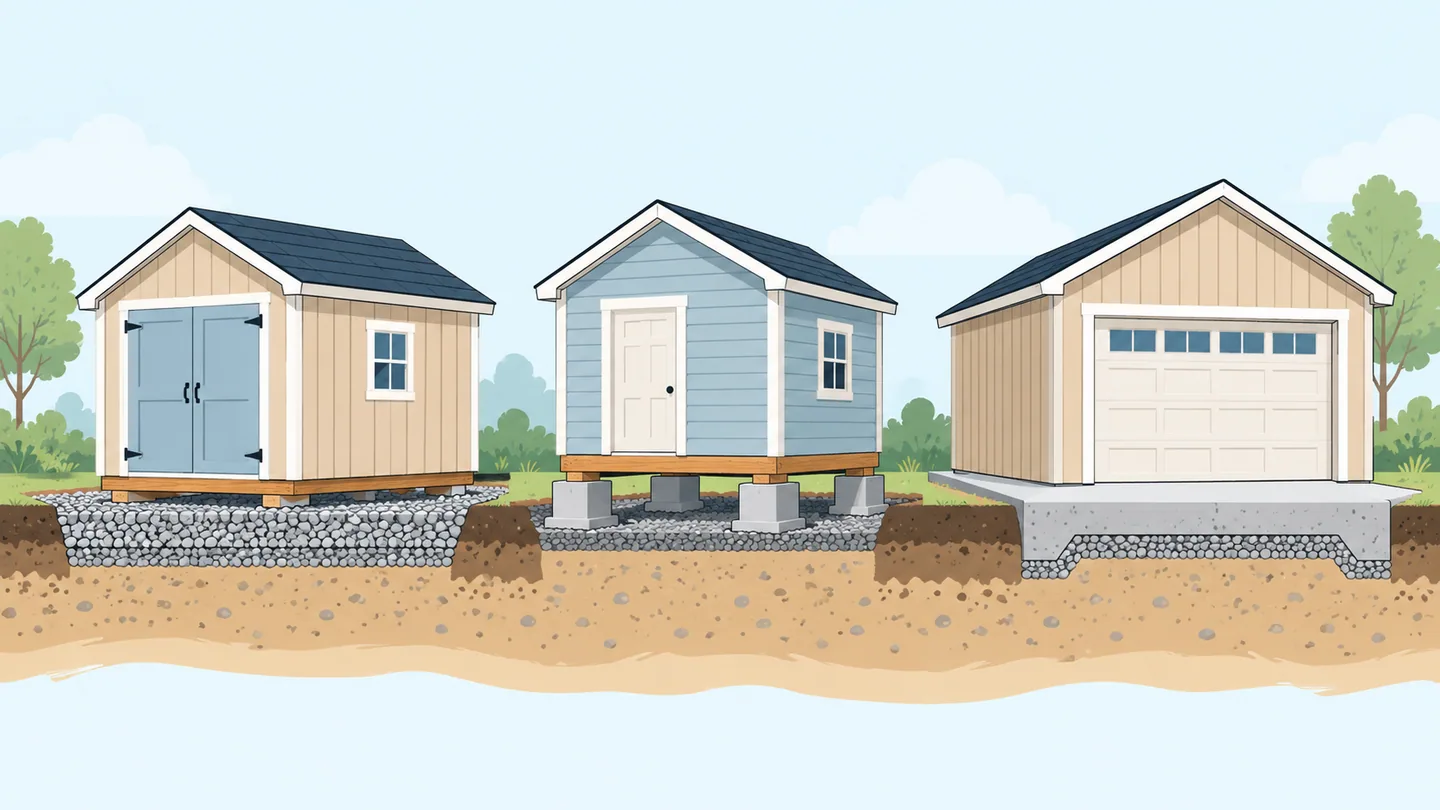
- Gravel pad. Compacted gravel in a leveled area. It drains and is quick to build, and it is the cheapest option. See gravel and frost depth.
- Skids on blocks. The shed’s floor frame rests on pressure-treated skids set over concrete blocks or pavers.
- Piers or footings. Concrete piers hold the floor beams. Depth follows the frost rule above, or the exemption.
- Slab. A poured slab, at least 3.5 inches thick under IRC R506.1, thickened at its edges. Many builders pour 4 inches.
- Frost-depth footings. Required when the shed is outside the exemption or your code asks for them.
How Many Piers or Footings Does a Shed Need?
The pier count equals the number of supports along each beam or skid, times the number of beams. With supports every 4 feet, a 12 ft beam needs four piers and a 16 ft beam needs five. A 12×16 shed with two beams then needs ten.
Pier spacing is a design choice. It depends on the beam or skid size, the floor load and your code. The 4-foot spacing is an assumed example, not a code figure, so use the spacing your plans or inspector give you. Two beams for a 10×12 shed with supports every 4 feet gives eight piers.
How Thick Should a Concrete Shed Slab Be?
A shed slab should be at least 3.5 inches thick under IRC R506.1, and many builders pour 4 inches. That is the code’s floor, not a design recommendation. For a heavy shed or soft soil, thicken the edges and consider a thicker slab with reinforcing.
The model code also calls for a base course of clean graded sand, gravel or crushed stone under a slab, 4 inches thick in the text we read. Your local code may adopt a different edition, so confirm the numbers. If you want a slab that does not heave, a frost-protected shallow foundation is possible only for buildings kept at 64 °F or warmer, which a shed is not.
Can a Shed Sit Directly on Gravel?
A small shed can sit directly on a compacted gravel pad where your code allows it. The gravel drains water away from the floor and spreads the weight, which suits a light shed on firm soil. It does not remove frost movement, and a gravel pad can still rise and settle a little.
Heavier sheds, larger sheds and sheds on clay soil often do better on piers. See gravel and frost depth for how gravel behaves in freezing ground.
Does a Shed Need a Permit?
A shed may need a permit even when it needs no frost footings. The 2021 IRC exempts a one-story detached accessory structure from a building permit if its floor area is 200 sq ft or less, and local codes often set a lower number. Frederick County, Maryland, sets 150 sq ft.
Zoning is separate. Setbacks, height limits and lot coverage can apply to a shed of any size. Ask your building department and your zoning office before you order, and ask your homeowners’ association too.
Why Do Shed Floors Heave and Doors Stick in Winter?
Shed floors heave and doors stick when frost lifts one corner of the foundation more than another. Piers or blocks above the frost line sit in freezing soil, and each one can rise by a different amount. The frame twists, and the door no longer fits its opening.
A building within the exemption is allowed to move a little. If it matters, level the shed in spring and again in fall. Frost heave explains the conditions behind the movement.
Questions People Ask
Does a shed foundation need to be below the frost line?
Not under the IRC if the shed is free-standing, light-frame, 600 square feet or less, and has eaves 10 feet high or lower. Larger sheds, and sheds in places that amend the rule, need footings below the frost line.
Does a 10x10 shed need a foundation?
A 10x10 shed is 100 sq ft, well under the 600 sq ft frost exemption, so it needs no frost-depth footings. It still needs a level, well-drained base, and many jurisdictions want a permit above their own size threshold.
How many footings for a 12x16 shed?
That depends on how you support the floor. With two skid beams and piers every 4 ft along each, a 16 ft run takes five piers per skid, or ten in all. Your skid and joist sizes set the real spacing.
Can I put my shed directly on gravel?
Yes, for a small shed where your code allows it. A compacted gravel pad drains water away and spreads the load. It does not stop the shed from moving a little with frost, which is why heavier or larger sheds go on piers or a slab.
Is 3.5 inches of concrete enough for a shed slab?
The IRC sets 3.5 inches as the minimum thickness for slab-on-ground floors. Many builders pour 4 inches, and a shed slab with a heavy load or soft soil should be thicker and thickened at the edges.
What Is Your Frost Line Depth?
Enter a ZIP code or city to see the depth your own building code sets.