
How Deep Should Farm Fence Posts Be?
On a farm fence the corner, end and brace posts hold the wire tension and go deepest, around 3.5 to 4 feet. Wooden line posts go at least 2 feet, and 3 feet is typical. This page gives depths, post sizes and spacing from university extension fencing guides, explains brace assemblies and T-posts, and covers when frost means digging deeper.
- Checked October 2026
- 3 sources
- How we verify
- Corner and brace postsAbout 3.5 to 4 ftDeeper in sand or wet soil. UGA Extension and Penn State Extension.
- Wooden line posts2 to 3 ftUGA: at least 2 ft, preferably deeper. Penn State: 36 in typical for horse fence.
- Corner and gate post size8 in or more at the topBrace posts 5 in or more. UGA Extension.
What Depths Do Extension Guides Give for Farm Fence Posts?
Farm fence posts go about 2 to 3 feet deep for wooden line posts and about 3.5 to 4 feet for corner, end and brace posts. These figures come from university extension fencing guides, and every one of them says to go deeper in sand or wet soil. No building code sets a farm fence post depth.
| Post | Depth | Diameter | Source |
|---|---|---|---|
| Wooden line post | At least 2 ft; 36 in typical | 2.5 in or more at the top | UGA C774; Penn State |
| Corner or gate post | Often 48 in | 8 in or more at the top | UGA C774; Penn State |
| Brace post | Matches the assembly, about 3.5 to 4 ft | 5 in or more | UGA C774 |
| Steel corner anchor, in concrete | 3.5 ft | 20 in square | UGA C774 |
| Dead man brace, end post | At least 4 ft | 10 to 12 in | UGA C774 |
Penn State Extension adds that corner and gate posts are about 25 percent larger in diameter than line posts, and that wire strand or mesh fences under tension need deeply set posts to resist it.
How Deep Should Corner and Brace Posts Be?
Corner and brace posts should be about 3.5 to 4 feet deep because they hold the full tension of the wire. The University of Georgia shows a double-span H-brace at 3 ft 6 in and adds that these depths are minimums, to be deeper in sand or wet soil. Its angle-brace guidance asks for an end post about 4 ft deep.
A brace assembly turns a wire’s pull into pressure on the ground. Four common forms from the extension guides:
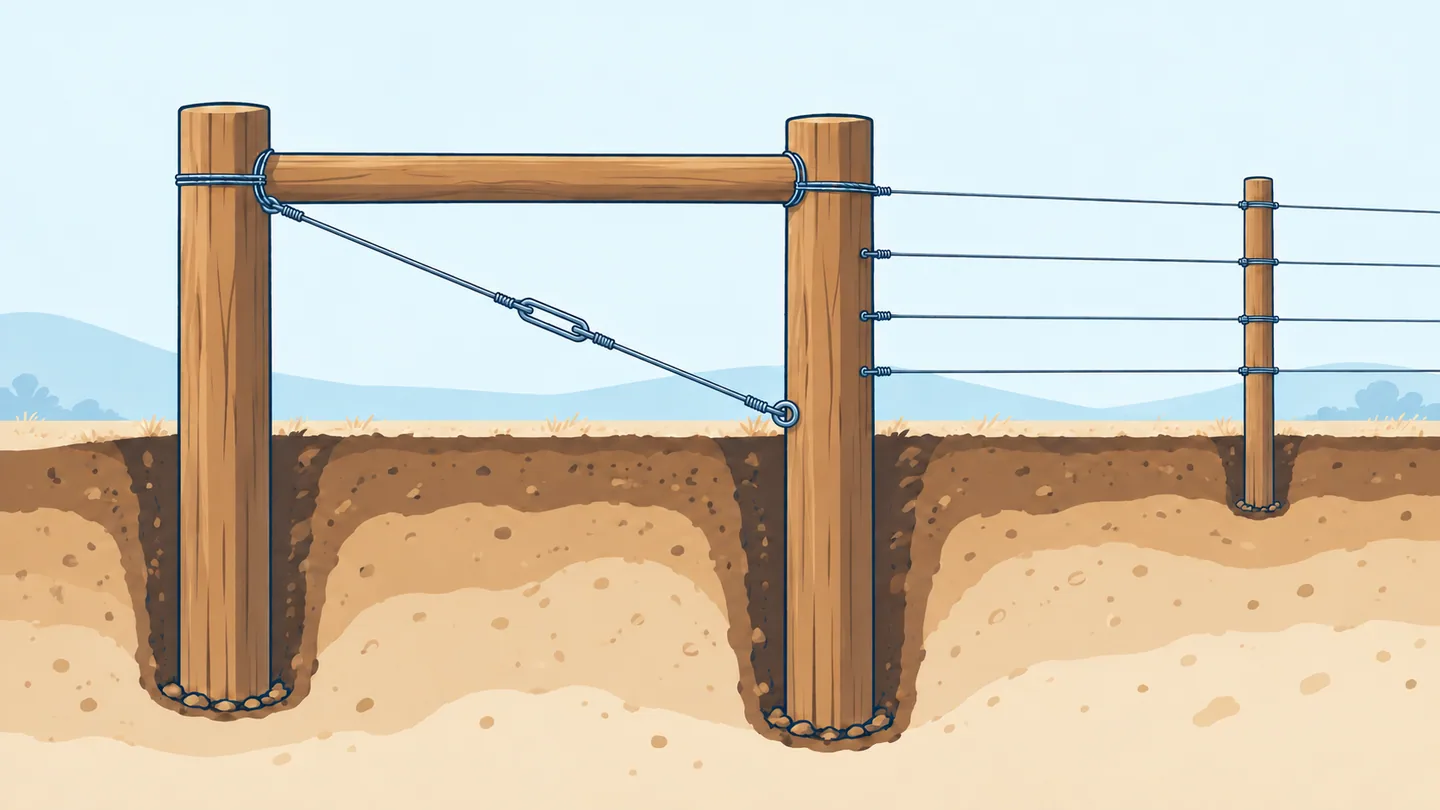
- H-brace: two posts joined by a horizontal rail, with diagonal wire. Georgia’s guide uses a double-span assembly whenever a fence span runs more than 200 ft.
- Steel corner anchor: steel assemblies set in a block of concrete 20 in square and 3.5 ft deep; brace anchors use 20 in square blocks 2 ft deep.
- Dead man brace: the end post is a large post of 10 to 12 inches, at least 4 ft in the ground, tied to a short post buried just under the surface.
- Angle brace: an end post set deep, with a 1 to 2 sq ft rock or piece of concrete under the angle post.
How Deep Should an 8 ft or 10 ft Post Be Buried?
An 8 ft line post set 3 feet deep stands 5 feet above ground, and a 10 ft line post set 3 feet deep stands 7 feet above. The University of Georgia gives a length rule: the height of the top wire, plus the depth in the ground, plus 6 extra inches.
| Case | Top wire height | Depth | Post length by the rule |
|---|---|---|---|
| Example A | 3 ft | 2 ft | 5 ft 6 in |
| Example B | 4 ft | 3 ft | 7 ft 6 in |
| Example C | 5 ft | 3 ft | 8 ft 6 in |
Pick the next stock length above the number. If you want a 10 ft post for a 4 ft top wire, the rule says you can bury it 5 ft 6 in; farm builders seldom bury that deep, so most use a 7 or 8 ft post.
Is 2 Feet Deep Enough for a Fence Post?
Two feet is enough only as a floor for wooden line posts. UGA Extension says line posts should be set at least 2 feet deep, preferably deeper, and Penn State’s typical figure is 36 inches. For corner, end and brace posts, 2 feet is far too shallow.
Taller posts and heavier wire loads call for deeper settings, so treat the extension figures as the starting point and add depth for sand, wet ground or a tall fence.
How Far Apart Should Farm Fence Posts Be?
Farm fence posts are usually 10 to 12 feet apart for most fences, with longer spans for suspension and high-tensile systems. UGA Extension spaces standard barbed wire line posts 10 to 12 ft apart, and suspension barbed wire 50 to 60 ft apart with stays between.
| Fence type | Line post spacing | Source |
|---|---|---|
| Most fences | About 10 to 12 ft | UGA C774 |
| Standard barbed wire | 10 to 12 ft | UGA C774 |
| Suspension barbed wire | 50 to 60 ft, with stays 10 to 12 ft apart | UGA C774 |
| Steel line posts supported by wood | A wooden post every 50 to 75 ft | UGA C774 |
| Curves | 8, 10 or 12 ft by offset | UGA C774 |
| High-tensile wire | Wider; depends on wind and slope | Penn State |
The Georgia guide gives no spacing for woven wire or high-tensile fences. Check the wire maker’s sheet for those.
How Deep Should Horse Fence Posts Be?
Horse fence posts follow Penn State Extension: line posts about 36 inches deep, and corner and gate posts deeper, often 48 inches. Horses lean on and kick fences, so these posts stay at the deep end of the range. A gate post must be deeply set and larger than the line posts to hold a swinging gate.
Penn State also says driven posts are more rigid, and recommends them over hand-set posts or posts set in predrilled holes. In wet or sandy soil, deeper settings and a collar of concrete casing may help.
How Deep Do T-Posts Go?
T-posts are driven until the anchor plate is beneath the surface. UGA Extension says studded T-posts need to be driven only that far, which gives a shallower setting than a wooden post. UGA Extension notes that steel line posts can be supported by a wooden post every 50 to 75 feet. Corner and brace assemblies in the extension guides use large wooden posts or steel anchors in concrete, at the depths listed above.
Do Farm Fence Posts Need to Go Below the Frost Line?
Farm fence posts do not need to reach the frost line under any building code, but posts in frost-heaving soil can loosen if they are too shallow. Penn State Extension says frost-heaving soils can loosen posts that are not driven deep enough. Deeper posts and good drainage reduce the risk.
If your frost line is deeper than the post depth in the tables, check the fence’s soil and the post type before choosing. Look up your frost line depth for your area, and read frost heave for the mechanism.
Should Farm Posts Be Set in Concrete or Tamped?
Wooden line posts are usually tamped in the ground, and the large corner and gate posts are the ones that sometimes get a concrete collar. Penn State suggests a concrete collar in wet or sandy soil. UGA’s steel corner anchors are set in concrete, 20 inches square and 3.5 feet deep.
Tamped soil lets a wooden post shed water and dry out, while concrete holds a post rigid. Many farm builders choose tamped soil for line posts and reserve concrete for corners, gate posts and steel assemblies.
Questions People Ask
How deep should an 8 ft fence post be buried?
As a line post, about 3 feet, which leaves 5 feet above ground. Penn State Extension gives 36 inches as a typical line post depth for horse fence. As a corner or brace post, an 8 ft post is too short; those go about 4 ft deep and stand taller.
Is 24 inches deep enough for a fence post?
For a wooden line post in firm soil, 24 inches is the minimum. UGA Extension says line posts should be at least 2 ft deep, preferably deeper. For corner, end and brace posts, 24 inches is far too shallow.
Is 2 feet deep enough for a 10 foot post?
For a line post it is the floor, not a target. A 10 ft post set 2 ft deep leaves 8 ft above ground, which is tall for a farm fence, so most builders go deeper. Never use 2 ft for a corner post.
How deep should horse fence posts be?
Penn State Extension gives a typical line post depth of 36 inches. Corner and gate posts are about 25 percent larger in diameter and set deeper, often to 48 inches. Sandy or wet soil may call for deeper settings.
How far apart should barbed wire fence posts be?
UGA Extension spaces standard barbed wire line posts 10 to 12 ft apart. A suspension barbed wire fence spaces line posts 50 to 60 ft apart with stays between them, roughly 10 to 12 ft apart.
What Is Your Frost Line Depth?
Enter a ZIP code or city to see the depth your own building code sets.