
How Deep Should a Sonotube Be?
A Sonotube is a cardboard form, not a depth rule. The concrete inside it must reach your required footing depth, which is below the frost line for a deck attached to a house. This page explains how deep to set the tube, what diameter your deck footing needs, whether you need a wider footing at the bottom, and how to set and strip the form.
- Checked October 2026
- 4 sources
- How we verify
- Depth is measured toThe bottom of the concreteFrom finish grade. IRC Table R301.2, footnote b.
- Tube sizes, Sonoco6 to 60 inIn 12 ft and 20 ft lengths. Retail stock varies.
- Round deck footing, Table R507.3.18 to 40 in acrossBy load, tributary area and soil. IRC 2021.
What Depth Should the Concrete in a Sonotube Reach?
A Sonotube should be set so that the bottom of the concrete reaches your required footing depth: at least 12 inches below undisturbed ground, and below the frost line for a deck attached to a house. The tube is a form, so it does not set the depth. The building code does.
Frost depth is measured to the bottom of the footing, from finish grade, under IRC Table R301.2 footnote b. Dig the hole to that depth, set the tube, and pour. Look up your frost line depth for the number your jurisdiction sets.
Do You Need a Footing Under a Sonotube?
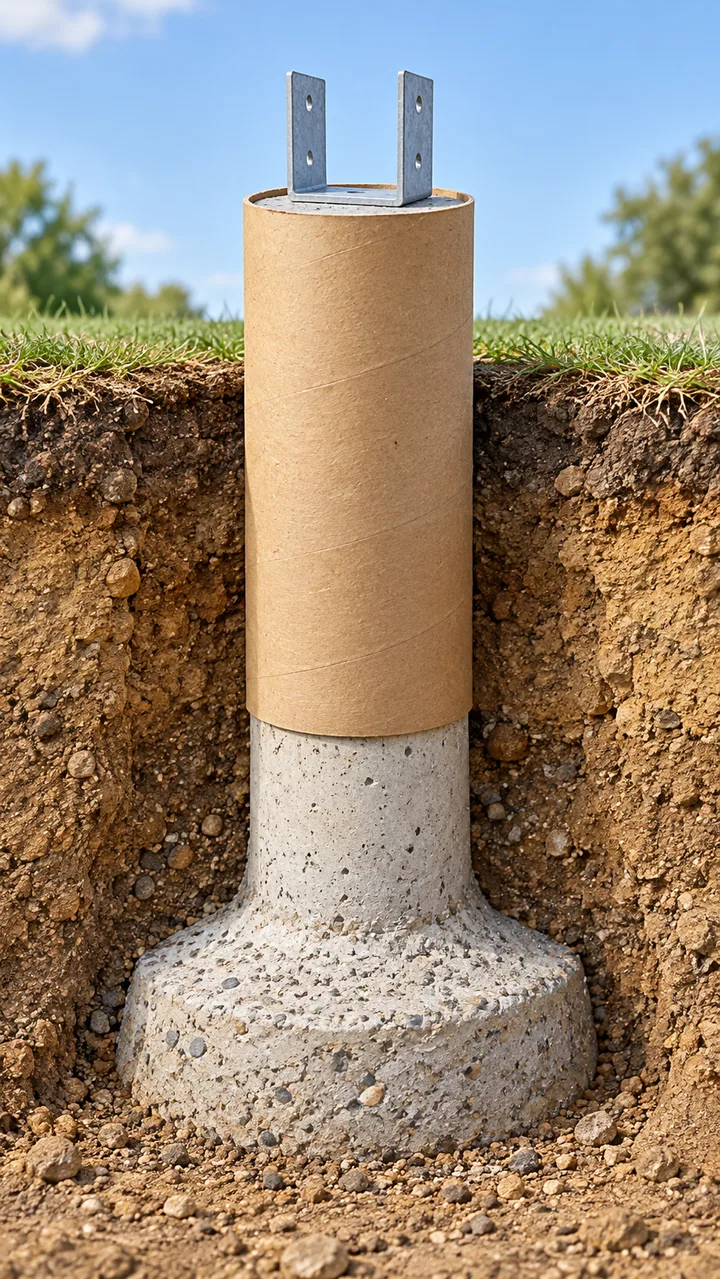
The concrete poured inside the tube is the footing, so a separate footing is not required in most cases. A wider base can help where the soil is weak or the load is large. You can pour a concrete pad first and set the tube into the wet concrete, or use a plastic footing form that widens the bottom.
Bigfoot-style forms are one example. Retail listings pair a 20 inch base with 6 and 8 inch tubes, a 24 inch base with 8 and 10 inch tubes, a 28 inch base with 10 and 12 inch tubes, and a 36 inch base with 12 to 18 inch tubes. Check the maker’s instructions for your size.
Does a Sonotube Need to Go to the Bottom of the Hole?
Yes. The tube should rest on firm, undisturbed soil at the bottom of the hole, or on a poured pad, so the concrete bears on soil at the required depth. A tube that hangs above the bottom leaves the footing short of the depth you dug.
Level the bottom first, remove loose soil, and brace the tube so it stays plumb. Do not vibrate the concrete from the outside of a Sonotube: Sonoco’s brochure says the forms should not be used with mechanical vibrators.
What Size Sonotube Do You Need?
The tube diameter must be at least the round footing diameter from IRC Table R507.3.1. The table gives round deck footings from 8 to 40 inches across, depending on the load, the area each post carries and the soil. Sonoco makes tubes from 6 to 60 inches, in 12 and 20 foot lengths.
The table below shows round diameters at a 40 psf load, in inches. Choose the next tube size up from your number.
| Area the post carries | Soil 1,500 psf | Soil 2,000 psf | Soil 3,000 psf or more |
|---|---|---|---|
| 20 sq ft | 12 in | 9 in | 8 in |
| 40 sq ft | 16 in | 14 in | 12 in |
| 60 sq ft | 19 in | 17 in | 14 in |
| 80 sq ft | 22 in | 19 in | 16 in |
| 100 sq ft | 25 in | 21 in | 17 in |
Can you use a 12 inch Sonotube for a 6x6 post?
Often, for light loads. A 12 inch tube meets the table for a post that carries up to about 20 square feet on 1,500 psf soil, or 40 square feet on firm 3,000 psf soil. It is too small for a post carrying 40 square feet on 2,000 psf soil, which needs 14 inches. The post size does not set the tube; the load and soil do.
How Far Can a Sonotube Stick Out of the Ground?
A Sonotube should stick out only far enough to keep the post base clear of the soil. The IRC sets no limit, and the post base maker’s instructions say how much concrete must show. After the concrete cures, cut and strip the cardboard above grade, since paper that stays wet in the soil will decay.
Leave the top of the concrete level and above grade so water runs away from it. For a deck, the post base sits on top, and the post stands on the base.
Why Do Sonotube Piers Heave?
Sonotube piers heave when the concrete is gripped by frozen soil and lifted. Water in the soil freezes into ice lenses that bond to the sides of the pier and push up. A pier whose bottom is above the frost line sits in that layer, and a pier whose bottom is below it is anchored by unfrozen soil.
Depth is the main defense. Frost heave explains the conditions.
Questions People Ask
Do I need a footing under a Sonotube?
The concrete inside the tube is the footing. If the soil is weak or the load is large, a wider base can spread the load, either a concrete pad poured first or a plastic footing form such as Bigfoot, which fits specific tube sizes. Table R507.3.1 tells you the diameter you need.
Does a Sonotube need to go to the bottom of the hole?
Yes. The tube should sit on firm, undisturbed soil at the bottom of the hole, or on a poured base, so the concrete bears on the soil at the required depth. A tube hanging above the bottom leaves concrete short of your depth.
Can I use a 12 inch Sonotube for a 6x6 post?
Often, for light loads. At 40 psf, a 12 inch round footing meets Table R507.3.1 for a post that carries up to 20 square feet on 1,500 psf soil, or up to 40 square feet on 3,000 psf soil. Heavier loads need a larger tube.
How far can a Sonotube stick out of the ground?
Only far enough to keep the post base out of the soil. The IRC sets no limit, but the post base manufacturer's instructions say how much concrete must show. Strip the cardboard above grade after the concrete cures.
What Is Your Frost Line Depth?
Enter a ZIP code or city to see the depth your own building code sets.