
Deck Footing Calculator
Enter your frost line depth, deck size and soil to get the footing depth your code requires, the footing size from the IRC deck table, how many footings you need and how much concrete to buy. Every result shows the rule it comes from.
- Checked October 2026
- 2 sources
- How we verify
How the Calculator Works
The calculator follows four steps, and each result names the rule behind it. It uses the 2021 International Residential Code. Your local code may adopt another edition or add rules, so treat the result as a planning number and confirm it with your building department.
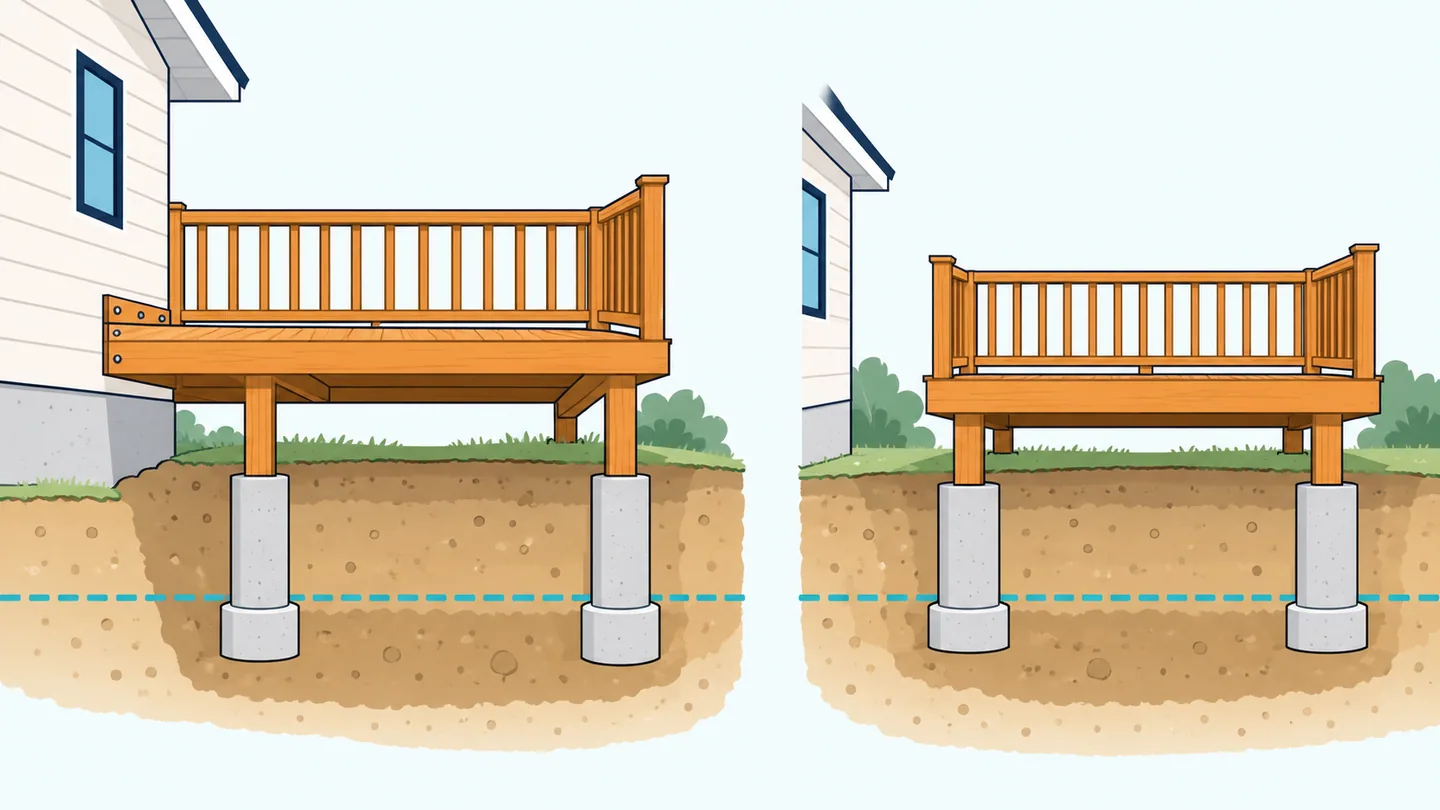
- Depth. For an attached deck it takes the larger of 12 inches and your frost line depth. For a free-standing deck it uses 12 inches. A deck that meets the pier-block exception shows “footings not required.”
- Size. It reads the footing size from Table R507.3.1 for your load, the area each post carries and your soil, interpolating between rows.
- Count. It counts posts as beams × (beam length ÷ post spacing, rounded up, + 1).
- Concrete. It multiplies the footing volume by the count and converts to bags.
How Deep Should Deck Footings Be?
Deck footings should be at least 12 inches below undisturbed ground, and below the local frost line when the deck is attached to the house. The calculator takes your frost line from the ZIP lookup, or you can type your own number if your department gave you one.
The full reasoning, with the 2018, 2021 and 2024 differences, is on deck footing depth.
How Is Deck Footing Size Calculated?
Deck footing size comes from IRC Table R507.3.1, based on three inputs: the area of deck a post carries, the load, and the soil’s allowable bearing pressure. A post carrying 40 sq ft at 40 psf on 2,000 psf soil needs a footing 12 inches square, or 14 inches round, and 6 inches thick.
The tributary area is roughly half the joist span plus any overhang, times the beam span between posts. The load is dead load plus live or snow load, whichever is higher. For soil, Table R507.3.1 lists 1,500, 2,000 and 3,000 psf columns; if yours is 2,500 psf, use the 2,000 column. If you do not know your soil, use 1,500 psf, which gives the largest footings.
How Many Footings Does a 12×12 Deck Need?
A 12 ft by 12 ft attached deck with one beam along the outer edge and posts 6 ft apart needs three footings. The middle post carries about 36 sq ft and each end post about half that. At 40 psf on 2,000 psf soil, the middle footing is about 12 inches square or 13 inches round.
The same arithmetic scales. Put the beam posts 4 ft apart and the 12 ft beam needs four posts, each carrying less area, so each footing is smaller. Joist and beam sizes set the longest spans you may use, and those come from span tables that this tool does not check.
What the Calculator Cannot Tell You
The calculator does not size stair footings, cantilevers, hot tubs or decks on slopes, and it does not read your soil. A deck carrying a hot tub, a roof, or a heavy load of planters needs an engineer’s design, because Table R507.3.1 assumes ordinary deck loads of 40 to 70 psf.
It also cannot know your local amendments. A city may set a deeper frost line than the model code, a larger minimum footing, or a rule about free-standing decks. Check with your building department before you pour, and book the footing inspection first.
Questions People Ask
How do I calculate the footing size for my deck?
Find the area each post carries, pick the load (40 to 70 psf) and your soil's bearing capacity, then read the footing size from IRC Table R507.3.1. Interpolate between rows if your area falls between two, but do not extrapolate past the table.
How many footings do I need for a 12x12 deck?
One footing per post. With one beam along the outer edge and posts 6 ft apart, a 12 ft deck needs three posts and so three footings. Wider spacing means fewer, larger footings.
How deep should my footing be for a deck?
At least 12 inches below undisturbed ground. If the deck is attached to the house, it must also be below your local frost line under the 2021 and 2024 IRC.
What Is Your Frost Line Depth?
Enter a ZIP code or city to see the depth your own building code sets.