
Do Freestanding Decks Need Footings Below the Frost Line?
Under the 2021 and 2024 IRC, a deck only needs frost-depth footings when it is attached to a house or other frost-protected building. A free-standing deck still needs footings at least 12 inches deep, and a small floating deck on pier blocks may need none at all. Some local codes are stricter. This page explains the rules by code edition, deck blocks, and the mistakes that turn a floating deck into an attached one.
- Checked October 2026
- 5 sources
- How we verify
- Frost depth, free-standing deck (2021, 2024)Not requiredR507.3.3 applies only to decks attached to a frost-protected structure.
- Minimum footing depth12 in (30 cm)Below undisturbed ground, R507.3.2.
- No footings at all200 sq ft or lessJoists on pier blocks, walking surface 20 in or less above grade.
What Do the 2018, 2021 and 2024 Codes Say About Free-Standing Decks?
A free-standing deck does not need footings below the frost line under the 2021 and 2024 International Residential Code. Section R507.3.3 requires frost protection only for decks attached to a frost-protected structure. The footings still must sit at least 12 inches (30 cm) below undisturbed ground, under R507.3.2.
The 2018 IRC goes further and exempts free-standing decks from the frost rule entirely, in R507.3.2 and R403.1.4.1. Your local code decides which edition applies to you, and it can add its own limits.
| 2018 IRC | 2021 and 2024 IRC | |
|---|---|---|
| Frost-depth footings | Not required for a deck not supported by a dwelling | Required only when attached to a frost-protected structure |
| Minimum footing depth | Free-standing decks exempt | 12 in below undisturbed ground |
| Where it is written | R507.3.2, R403.1.4.1 exception 3 | R507.3.2, R507.3.3 |
What Is the Difference Between Attached, Freestanding and Floating Decks?
An attached deck connects to the house, usually through a ledger board, and so shares the house’s frost-protected foundation. A free-standing deck stands on its own posts, with no connection to the house. A floating deck is informal shorthand for a low free-standing deck that rests on blocks or footings at grade.
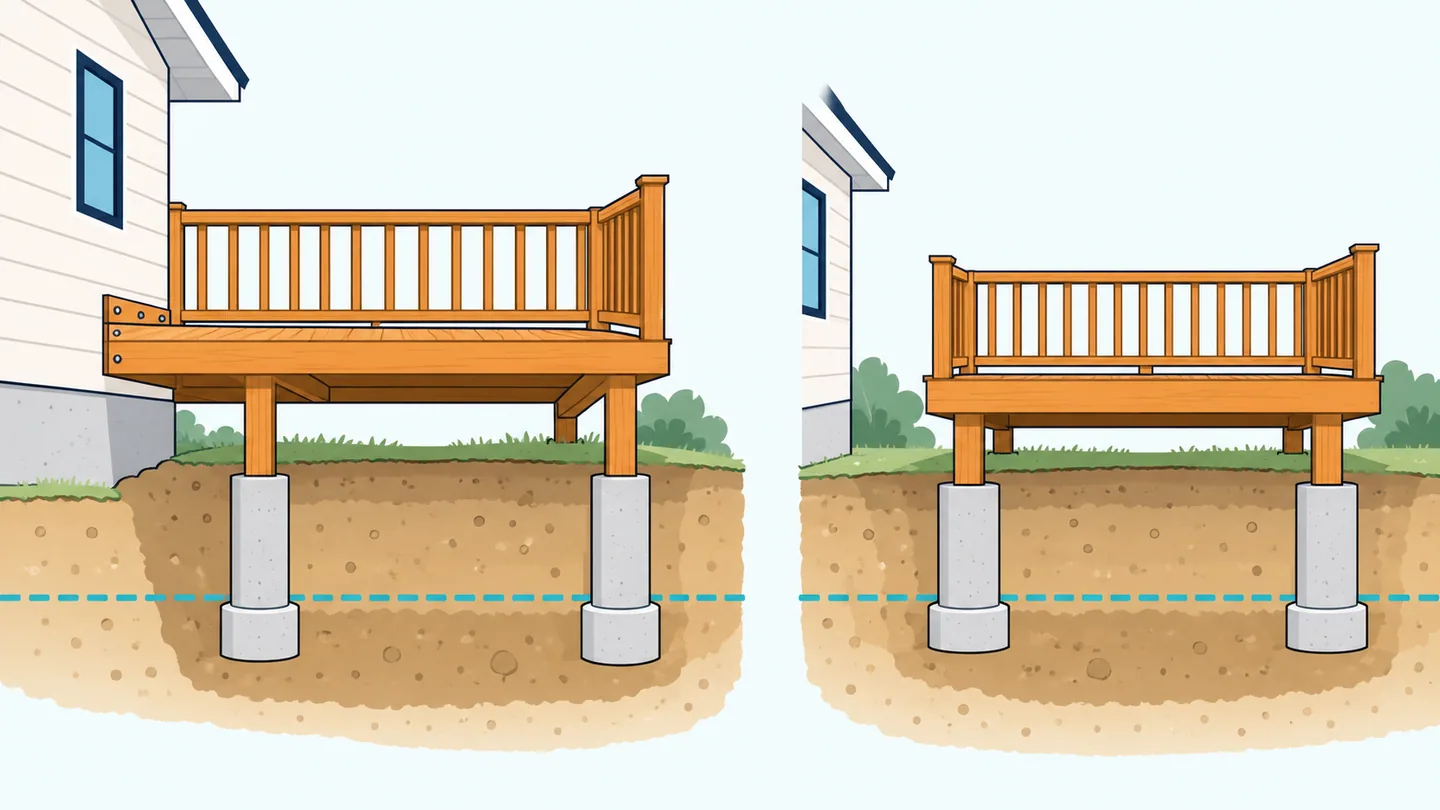
| Type | Connected to the house? | Frost rule (2021, 2024) |
|---|---|---|
| Attached | Yes, through a ledger | Footings below the frost line, on rock, or another approved method |
| Free-standing | No | 12 in below undisturbed ground; no frost depth |
| Floating (pier-block) | No | Possibly no footings, if it meets the exception below |
The code never uses the word “floating.” What matters is whether the deck meets the exception language, so read the next section before you rely on the label.
When Does a Deck Need No Footings at All?
A deck needs no footings in two cases under R507.3 of the 2021 and 2024 IRC. Either the joists rest on the ground over their entire length, or the deck is a small pier-block deck that meets three conditions at once.
- Joists on grade. The joists lie on the ground for their whole length.
- Pier-block deck. The joists bear directly on precast concrete pier blocks at grade, with no beams or posts. The deck is 200 sq ft (18.6 m²) or smaller. The walking surface is no more than 20 in (508 mm) above grade at any point within 36 in (914 mm) of its edge.
Missing any one condition removes the exception. A 10 ft by 24 ft deck is 240 sq ft and does not qualify, even if it sits low.
Can You Use Concrete Deck Blocks Instead of Footings?
You can use concrete deck blocks instead of footings only for a deck that meets the pier-block exception above. A block deck with posts, with beams, over 200 sq ft, or higher than 20 inches near the edge needs footings that reach 12 inches below undisturbed ground.
Deck blocks are made for light loads, and each maker publishes its own load rating. Check the one printed on your product, because the code language limits where blocks are allowed but does not rate them.
Two mistakes turn a “floating” deck into one that needs footings: adding a railing post that rests on the deck blocks, and tying the deck to the house with a ledger. A ledger makes it an attached deck, and the frost rule applies.
Do Local Codes Ever Require Frost Footings for Free-Standing Decks?
Yes, some local codes remove or tighten the exemption. Frederick County, Maryland, amends its adopted code so that a deck not supported by a dwelling needs footings once it exceeds 150 sq ft, unless the joists bear on earth. That is stricter than the model code’s 200 sq ft.
The model code is a starting point, and each city or county adopts and amends it. The only reliable check is your own jurisdiction’s adopted code. Look up your frost line depth to see which authority sets your rule, then ask that department how it treats free-standing decks.
How Deep Should Freestanding Deck Footings Be?
Free-standing deck footings should be at least 12 inches below undisturbed ground, and deeper if your local code says so. Where the soil is soft or the ground freezes, many builders still dig below the frost line to stop seasonal movement, though the model code does not require it.
That choice is practice, not code. It trades more digging for a deck that stays level. The deck footing depth page gives footing sizes by load and soil, and the deck footing calculator turns your dimensions into a footing size and count.
Why Do Freestanding Decks Still Move in Winter?
A free-standing deck moves in winter when frost lifts whatever sits in the frozen layer of soil. Water in the soil freezes into ice lenses and pushes upward, and a footing or block above the frost line sits inside that layer. When the soil thaws it settles, often unevenly.
Because the code allows shallow footings, a code-compliant free-standing deck can still shift a little each year. The movement is smaller on a light, low deck. Frost heave explains the three conditions that cause it.
What Are Common Floating Deck Mistakes?
The common mistakes are all ways of leaving the exception without noticing.
- Building larger than 200 sq ft on pier blocks.
- Adding posts or beams on top of blocks.
- Setting the walking surface more than 20 in above grade near the edge.
- Attaching a ledger to the house and treating it as free-standing.
- Placing blocks on topsoil or fill instead of firm, undisturbed ground. This one is practice, not code.
- Skipping the permit check. Many departments want to see even a low deck.
Questions People Ask
Do you need footings for a floating deck?
Only sometimes. A free-standing deck of 200 sq ft or less, with joists resting directly on precast pier blocks and a walking surface no higher than 20 inches near the edges, needs no footings under the 2021 and 2024 IRC. A bigger or higher deck needs footings at least 12 inches deep.
Can I use concrete deck blocks instead of footings?
Yes, but only inside the exception: joists bear directly on the pier blocks, with no posts or beams, the deck is 200 sq ft or less, and the walking surface stays within 20 inches of grade within 36 inches of every edge. Break any of those and the deck needs real footings.
Do deck footings need to be below the frost line?
For an attached deck, yes. For a free-standing deck under the 2021 and 2024 IRC, no; 12 inches below undisturbed ground is the rule. The 2018 IRC exempts free-standing decks from the frost rule. Check local amendments, because some counties require more.
What is the 3-4-5 rule for decks?
It squares a layout. Mark 3 ft on one side and 4 ft on the other; the diagonal between the marks must measure 5 ft. For a more accurate check on a bigger deck, use 6, 8 and 10 ft.
What Is Your Frost Line Depth?
Enter a ZIP code or city to see the depth your own building code sets.